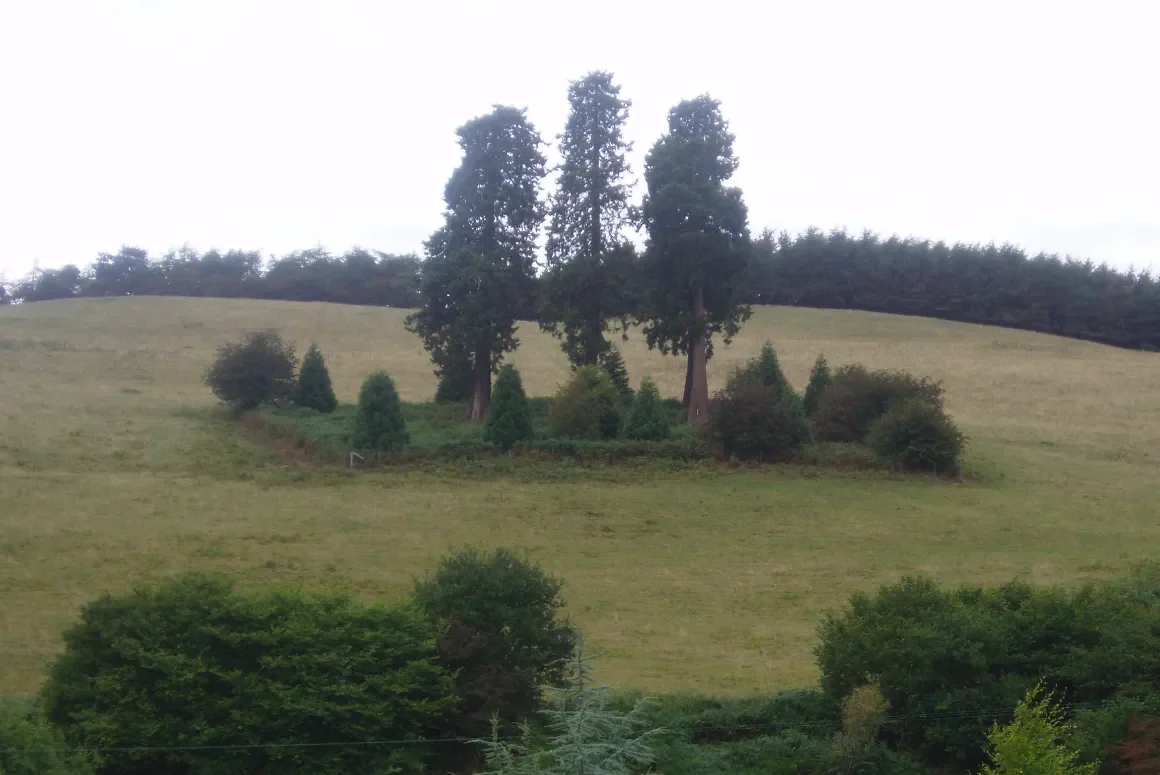
You can see the four wellingtonia trees from a distance. They stand out, tall and rather incongruous. They don’t quite fit in to the beautiful landscape around them. They had to be planted here for a reason.
They mark the place where they buried the bones.
When you get close, you are aware of just how steep it is. It is a brisk walk up from the road. You can’t hurry.
Now think what it would be like in battle. The screams, the fear, the arrows raining down upon you…It is a really stupid place to choose to fight for your life.
This is the tiny hamlet of Pilleth, near Knighton. The site of the battle on 22 June 1402 which marked Owain Glyndwr’s most famous victory over the English armies.
Today it is a beautiful place. As you stand in the grounds of St. Mary’s church, high on the hill, you have unparalleled views over towards Offa’s Dyke. Peaceful rolling countryside. Why would anyone want to fight in a place such as this?
But it wasn’t always like this. It was less gentle then, more treacherous. Then these beautiful hills were covered in forest and the valleys dense, dark and swampy.
And it along such a valley that the Welsh came.
The Welsh uprising began as a land dispute and became a rebellion that lasted ten years. There had been simmering resentment across Wales for some time. The English were an army of occupation and had been so for over a century. The Welsh were regarded as second class. They were treated differently under the law. There were taxes the Welsh had to pay that others did not. They could not own land within ten miles of a town. They had to swear allegiance to the king before they could own a weapon. Their land was ringed by the great castles of Edward I, symbols of English dominance.
They felt like an oppressed people. Such resentments would inevitably find an expression.
It all started in the north.
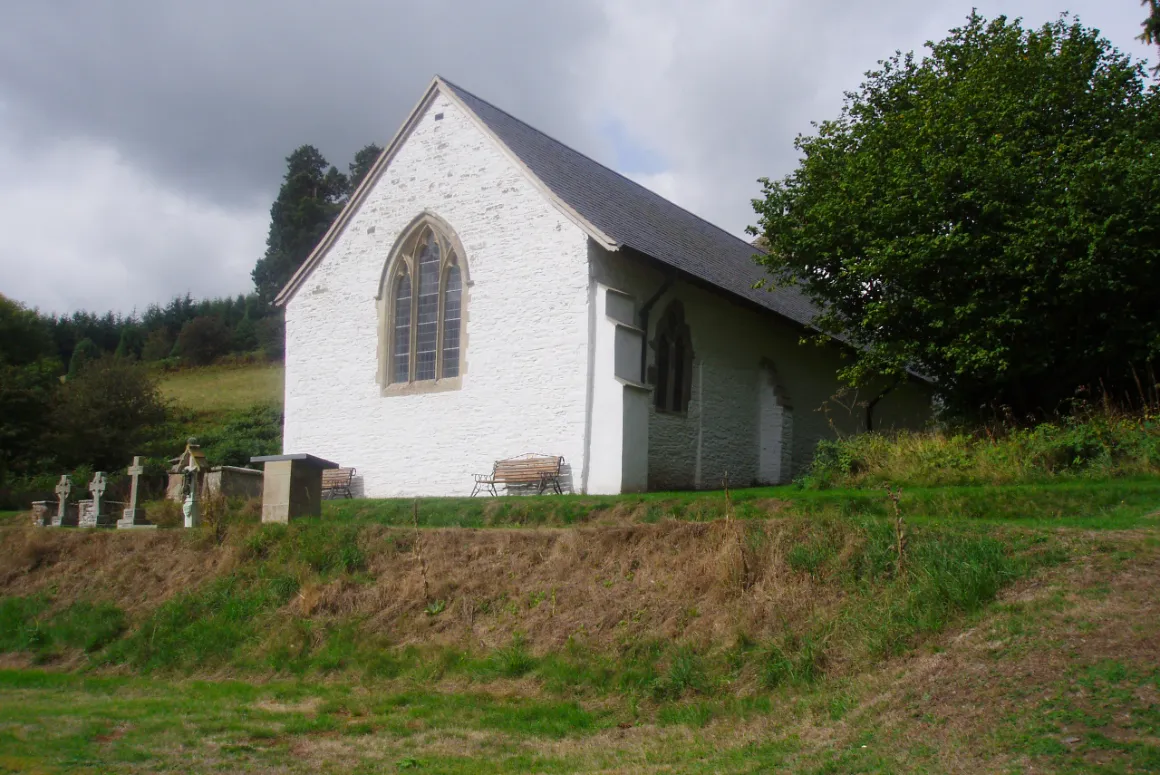
St Mary's Church, Pilleth
King Henry awarded a piece of unlawfully appropriated land to a supporter, Lord Grey of Ruthin, rather than to the local landowner, Owain Glyndwr.
Following a successful military career Glyndwr had become a respectable middle aged country gentleman. Yet he was moved to arms and rebellion. The land issue was a symbol of oppression. Soon he was proclaimed The Prince of Wales. This was a highly symbolic gesture. He was a Welshman, not an English imposition. The portents were highly significant..
The stream where Llewellyn’s head had been washed was seen to run red with blood. Soon supernatural powers were ascribed to him – invisibility, control of the weather. In the Great War of Liberation, he was its hero.
The first stage was when Owain Glyndwr’s men destroyed Ruthin. They moved on to other castles. Henry IV’s counterattack was unsuccessful. He withdrew, unable to confront the fast-moving guerrilla forces that would attack and melt away into the hills. Glyndwr was not foolish enough to confront a superior force in open battle.
This provoked greater repressive legislation. Mixed Welsh/English marriages were forbidden. The Welsh were not allowed to offer shelter to overnight guests. Of course, this only served to fuel the rebellion.
Edmund Mortimer, aged 26, was sent to deal with the threat. He gathered his army in Ludlow, recruiting them along the border from tenants of the Mortimer estates. Many were eager to join, fed up with the regular Welsh raiding parties. They usually came along the river Lugg, along what is known as the invasion corridor. This time they would be driven back.
Mortimer went out to meet them.
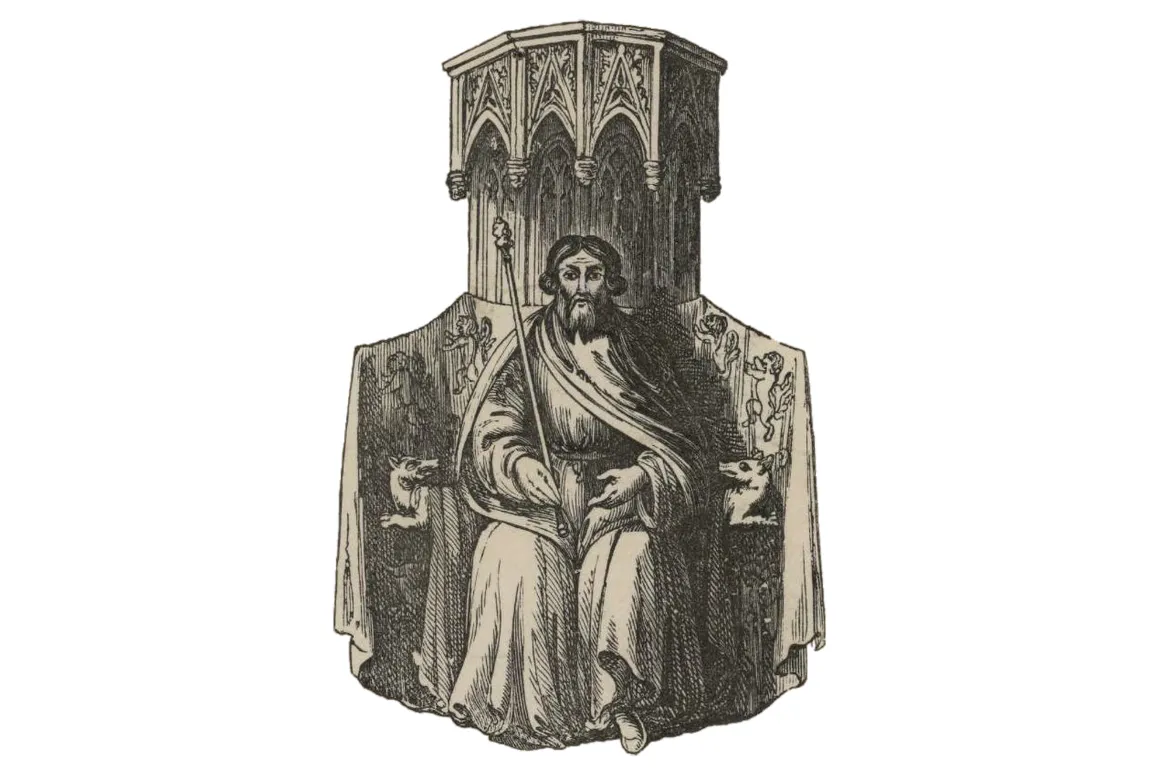
Portrait of Owen Glyndwr from his great seal
His was a large force. Looking across the centuries, it is hard to estimate the size of his army. He had at least 2000 men, perhaps many more. It was a large and formidable force that arrived in the village of Whitton on 21 June 1402. They had only just crossed Offa’s Dyke. They were only a short distance from home. A day later more than 800 of them were dead.
They would have seen the Welsh fires on the hill just a couple of miles away, waiting for them. Who were they? Nothing more than men from the hills, ill-disciplined, unsophisticated outlaws. Merely raiders and camp followers, speaking a strange language. Give them a beating. Send them home.
As you look at it today you can see how the terrain helped determined the outcome. It isn’t such an advantage today to command the skyline. But in those days the high ground was the key advantage. We can only marvel at the arrogance and the stupidity of a man who believed he could defeat a highly experienced army, fighting up a slope such as this. The gradient in parts is 1 in 4. How could he have possibly thought he could win?
They marched out the next morning, a short step along the valley. At the top of the hill called Bryn Glas the Welsh seemed a much inferior force. Insubstantial perhaps, just waiting to be attacked.
But Mortimer could see only part of the troops. Half of the Welsh force had been hidden in a wood to the left. Glyndwr himself may or may not have been there, but the commander, Rhys Gethin (The Fierce) from Cwm Llannerch near Conwy, had out-manoeuvred Mortimer before the fighting started.
The battle was brutal, bloody and brief.
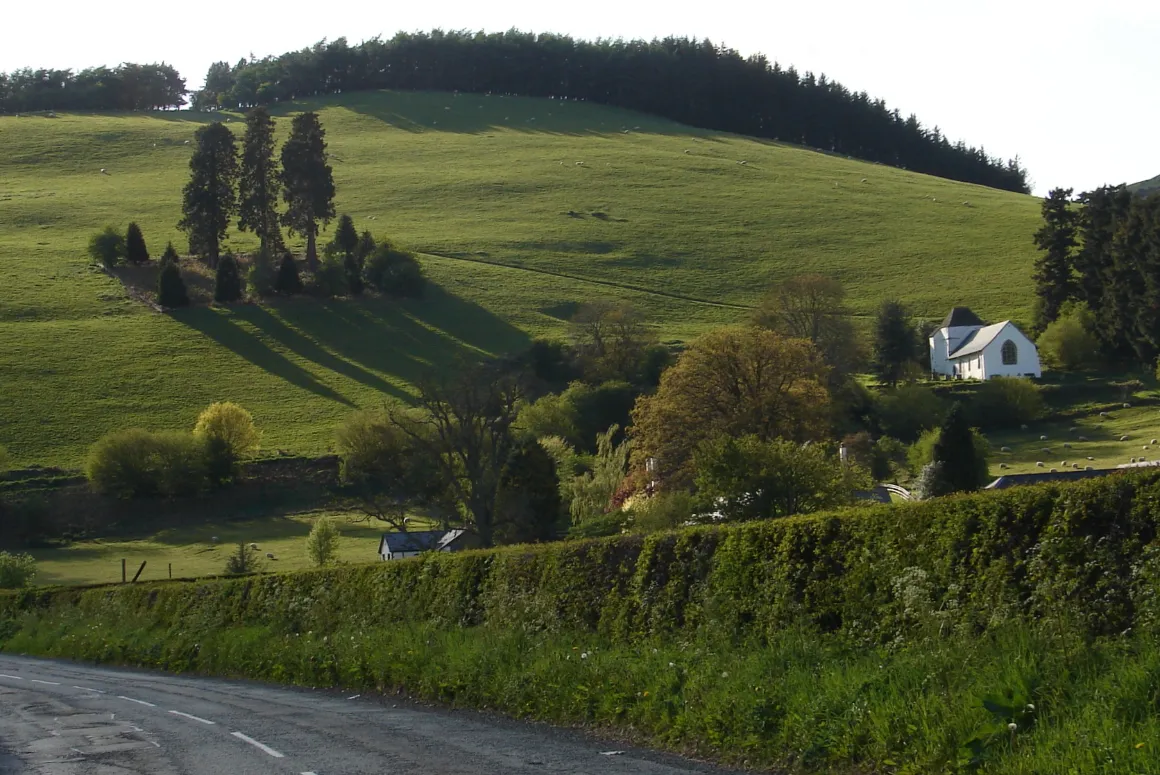
Bryn Glâs
The two sides faced each other and began by exchanging archery fire. The longbow was the fifteenth century’s weapon of mass destruction, striking fear into the hearts of European opposition. However, this time it was different. The Welsh had long bows too.
And they had the high ground. So they had greater range and easier deployment. Under a sustained and targeted barrage the English could not retaliate successfully. They took heavy casualties before they could even start up the steep slope. When they did charge they were disorganised and ragged and easily picked off.
On one flank Mortimer had deployed some conscripted Welsh archers of his own. However pretty soon they could see the way the battle was developing. They didn’t want to be caught on the wrong side. Their colleagues at the top of the hill could have become a little miffed at their presence in an English army.
So, perhaps sensibly, they decided to switch sides. Was this a cunning predetermined betrayal, a tactical master-stroke by Gethin the Fierce as some have said? Or an opportunity seized for self preservation? It was certainly a decisive moment.
The Welsh charged down the slope to crash into the struggling English and the hidden troops emerged from the trees. In the ensuing and brutal hand to hand fighting the English didn’t have a chance. Soon, those who could, retired from the field in disorder. St. Mary’s Church, the dividing line between the two forces was burning. Casualties were huge. 800 English dead, perhaps more and Edmund Mortimer captured.
Stories are told about the horrible mutilation of the English dead, carried out by the women in the Welsh camp. Welsh patriots are always quick to reject this as a wicked slur. Shakespeare however was happy to repeat the story in Henry IV Part 1.
…the noble Mortimer
Leading the men of Hereford to fight
Against the irregular and wild Glendower,
Was by the rude hands of that Welshman taken;
A thousand of his people butchered,
Upon whose dead corpse there was much misuse,
Such beastly, shameless, transformation
By those Welsh women done, as may not be,
Without much shame, retold or spoken of.
Mortimer was held for ransom but Henry IV refused to pay. He was, allegedly, strapped for cash. The potential difficulties this might have caused Mortimer were easily solved. Following the example of the Welsh archers who had begun the battle on Bryn Glas at the bottom of the hill and then teamed up with those at the top, he too switched sides. He signed a pact with Glyndwr to overthrow Henry, an agreement Mortimer sealed by marrying his daughter Catrin.
This was a high point of the rebellion. Wales was a threat and had to be taken seriously. Glyndwr summoned parliaments and signed treaties. Wales was almost an independent country. But it came to nothing. The English certainly took the Welsh seriously now. They came back, and the Welsh became pinned down in the English castles they had taken, facing a much larger force, their army fighting a different sort of war and their resources quickly exhausted. Owain Glyndwr’s own lands in the north of Wales were ransacked and the area he controlled shrank rapidly.
Mortimer became Glyndwr’s primary military adviser but died of starvation inside a besieged Harlech castle in 1409. Here Glyndwr’s wife, daughter and four grandchildren were taken captive. His own last days remain shrouded in mystery and myth. He became a fugitive, probably dying in 1406 at the home of his daughter Alice in Monnington Straddel in Herefordshire.
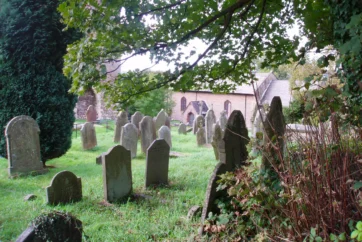
Pilleth is an ancient place and it feels like one too. It is one of the few places in Wales mentioned in the Domesday Book. The name probably derives from Pwll y Llethr, “The Pit on the Slope.” This is a reference to the holy well of St. Mary that you can still find in the northern corner of the churchyard. Indeed this healing spring, especially effective for eye problems they said, is probably why the church was built here in the first place. It was destroyed in the battle in 1402 and then again by fire in 1894. But the church remains a fine building. Isolated, without a natural community, it still has a timelessness about it.
It is hard to equate the beauty of what you see around you with the awful events of battle.
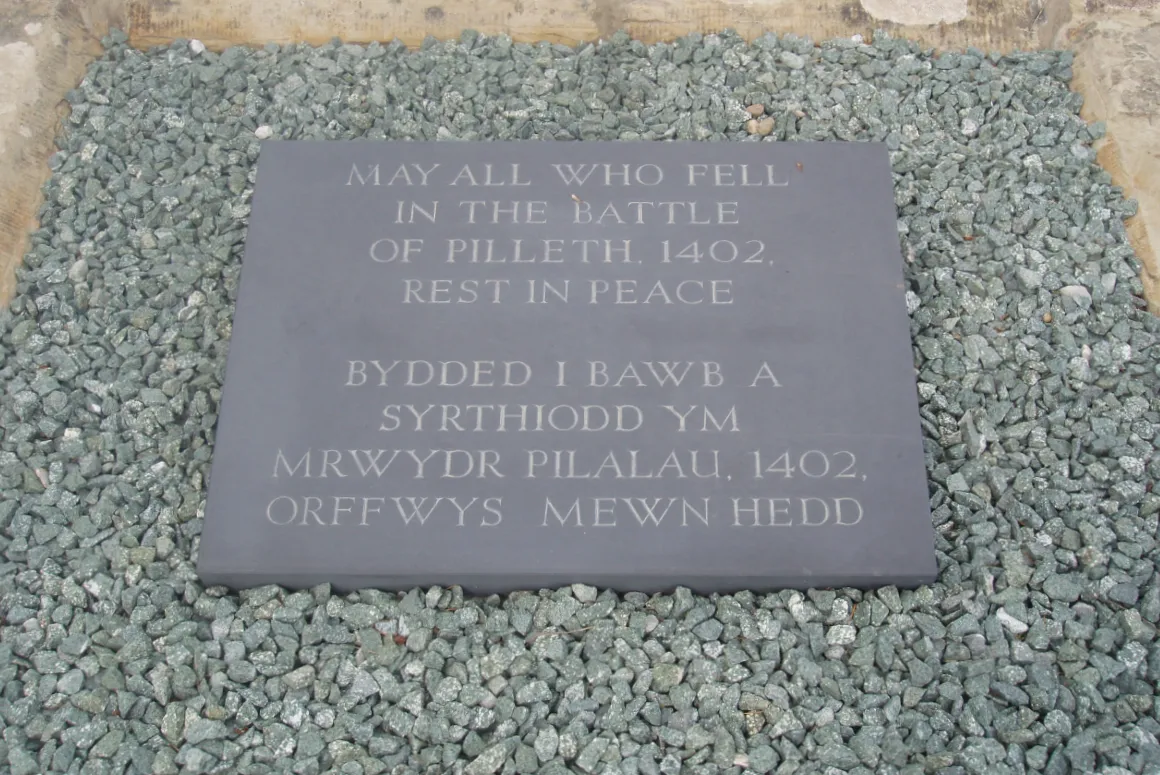
Above the church you will see the trees. They were planted by the M.P. for Radnor, Sir Richard Green-Price, when drainage work on the hill started to uncover bodies in the nineteenth century. Members of his family now rest in the churchyard, along with the ancient dead, an elegant slate memorial remembering the events of all those years ago.
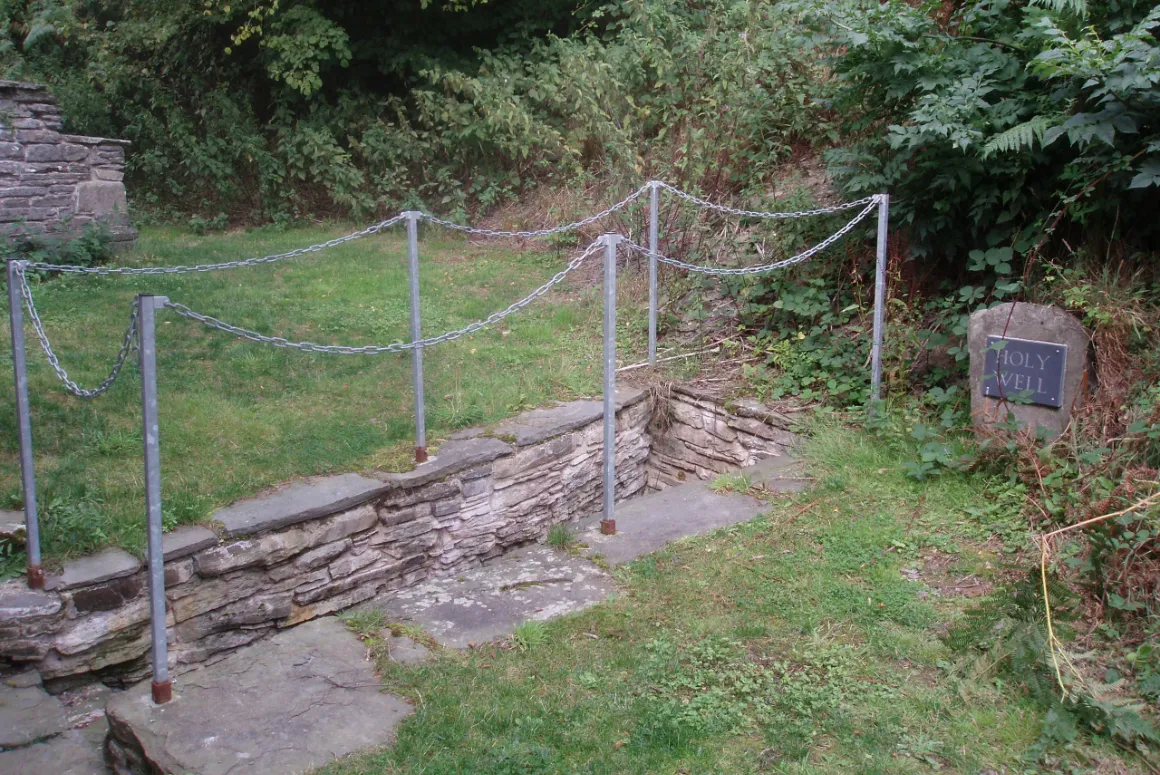
The holy well of St. Mary
Some say that Pilleth isn’t the place of the battle at all. They place it a little further away, near Bleddfa. They say that there are four burial mounds for the dead there. But it all happened such a long time ago. No one will ever truly know where it happened. The church of St. Mary at Pilleth is as good a place as any to remember the dead.
Words: Geoff Brookes
Image attributes:
All images by Geoff Brookes except:
Portrait of Owen Glyndwr from his great seal – Jr8825, CC BY-SA 4.0, Source
Bryn Glâs – Ian Paterson, CC BY-SA 2.0, Source