Karen Foy looks at the fascinating history behind North Wales’ quarrying industry.
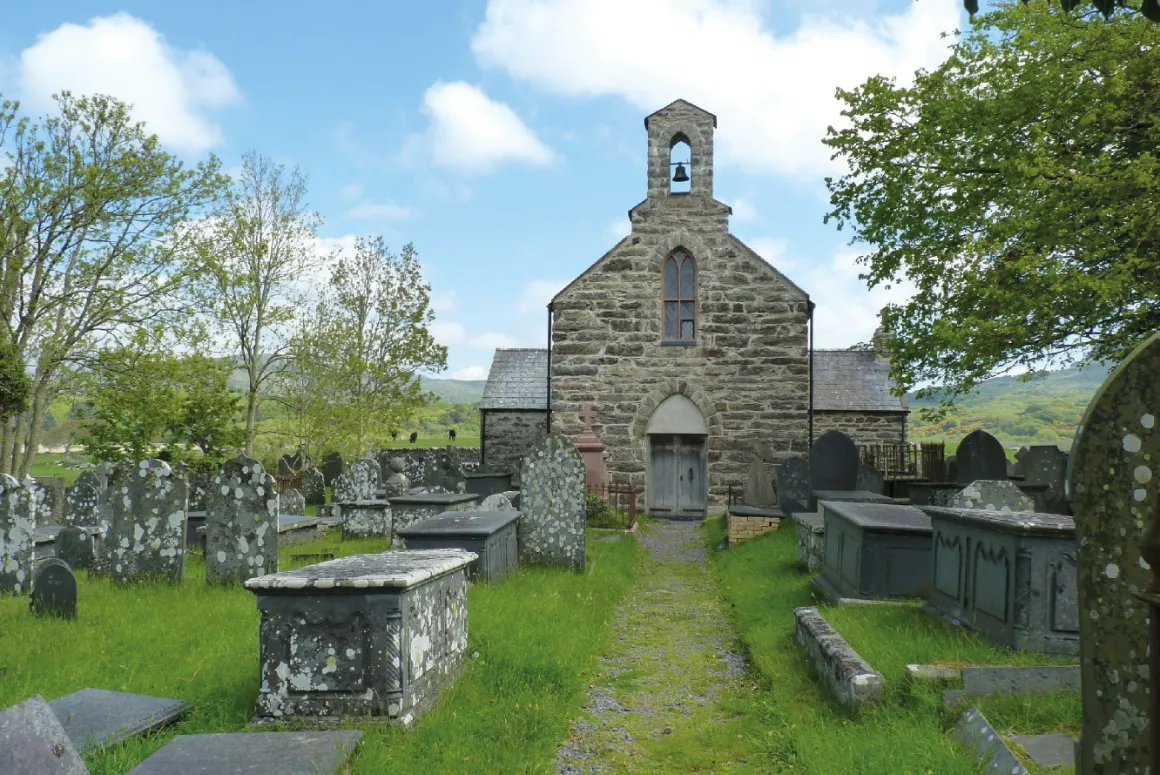
The church of St Cynhaearn is situated in the rolling Welsh countryside just outside Pentrefelin near Porthmadog. I visited it on a sunny morning in May 2013, but I should imagine the scene looked much the same in May 1813. This beautiful spot is the final resting place of some intriguing local inhabitants, but it was the memorial of one particular individual that I had come to find.
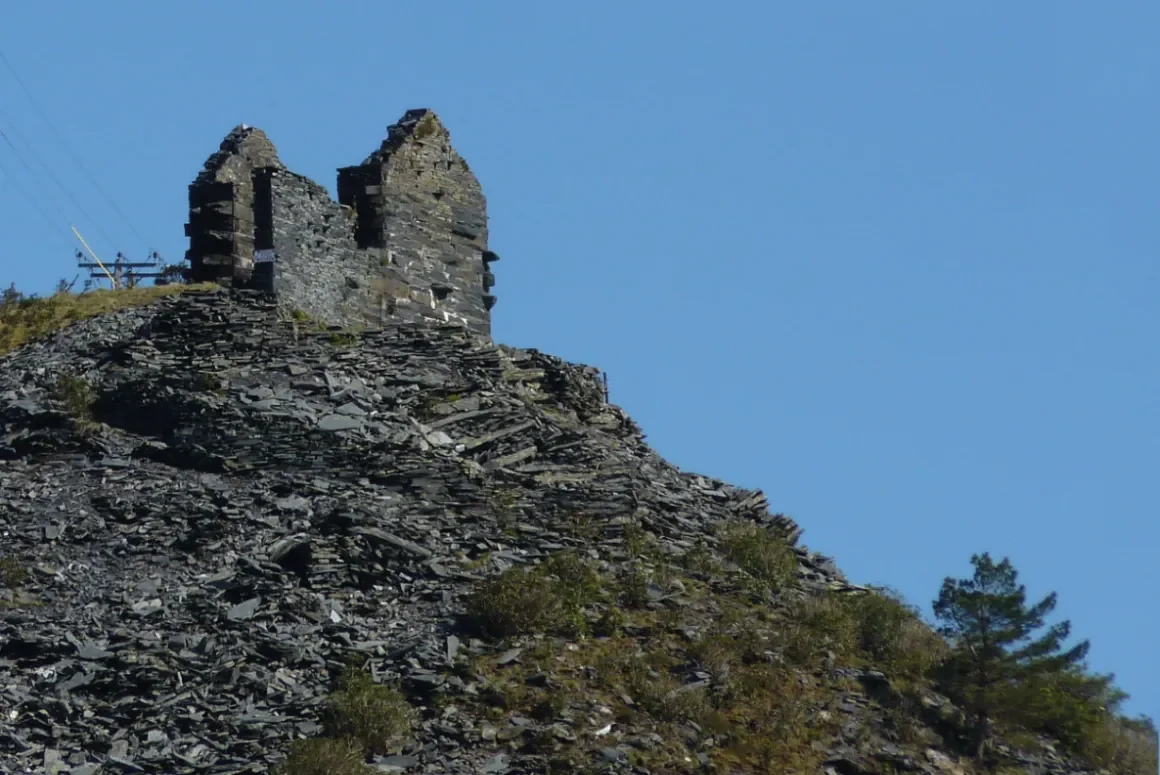
Feature image: Remains of slate workings, Blaenau Ffestiniog. Credit: Karen Foy
Along the boundary wall to the right is a large stone urn enclosed by decorative iron railings. The branches of a yew tree seem to gently cradle the ornamental vessel. This is the memorial to James Spooner 1790-1856.
Born in Leigh near Worcester, Spooner came to Wales in 1818, and after an earlier career with the Ordnance Survey, he was given the task of surveying the route for a railway that would travel from the slate quarries in the hills around Blaenau Ffestiniog to the harbour at Porthmadog.
His engineering skills enabled a gravity-fed railway – with a gradient of 1 in 80 for twelve miles – to carry the slate on the downward journey much quicker than the existing horse and cart method. The horse would travel down on the railway with the slate and then haul the empty slate wagons along the rails, back up to the quarries.
James continued to work at what became the Ffestiniog Railway for the rest of his life, overseeing construction, consulting with pioneering engineer Robert Stephenson and even becoming a quarry agent. His peaceful resting place belies his busy and productive life, but James was only one cog in the massive wheel that was the Welsh slate industry, and some of us with Welsh roots may also have ancestors who played their part on the ‘front line’ of extracting what was to become a global commodity.
A Chip Off the Old Block
By the end of the 18th century, the versatility of slate as a natural building material had rapidly increased demand for the product. Villages throughout Wales were transformed into busy industrial towns, and tiny harbours became bustling ports as the slate industry flourished. Welsh slate was shipped abroad, providing employment for thousands. By the late 19th century, the Dinorwic, Penrhyn and Blaenau Ffestiniog quarries were some of the largest in the world.
But the working conditions of the quarrymen were unforgiving. Each worker had to complete a five year apprenticeship before he could class himself as qualified. As early as the age of ten, many young boys would serve a premature apprenticeship where they would deliver blunt tools by cart from the quarry to the blacksmith’s shop for sharpening. They would learn how to split and chip the slate and, later, move on to become journeymen – or a jermon – by chipping the slates of a regular quarryman.
The work of the ‘rockmen’ was equally tough. Suspended from ropes over the side of the rock face, they would use hammers and chisels to chip away at each terrace of slate. They would learn where to place explosives to get the best results when quarry blasting, and were expected to work in all conditions: summer, when the sun reflected back at them from the surface of the rock; winter, when rainfall made the slate slippery to stand on.
Slate was blasted from the rock face by the explosive gunpowder. Dynamite or gelignite was considered too fierce, shattering the slate, and so only used to remove the surrounding rock and rubble to expose the slate vein. The gunpowder was stored in a special Powder House, and workers had to wear copper-soled clogs to reduce the danger of creating a spark which would ignite the explosive. The required amount was then carried to the quarry in a cloth or rubber powder bag – yet another day-to-day hazard of their work.
The slate was extracted in large blocks and reduced in size by mallet and chisel, cutting across the grain – this part of the process was later replaced by sawing. Each worker would then have a manageable portion to work with and, by splitting the slate down the grain, an experienced worker using an anvil and a knife known as a whittle could obtain four roof slates from a piece approximately one inch thick. At the end of the day, these were carried outside and piled in the Stacking Plot, counted in threes and graded by size and thickness.
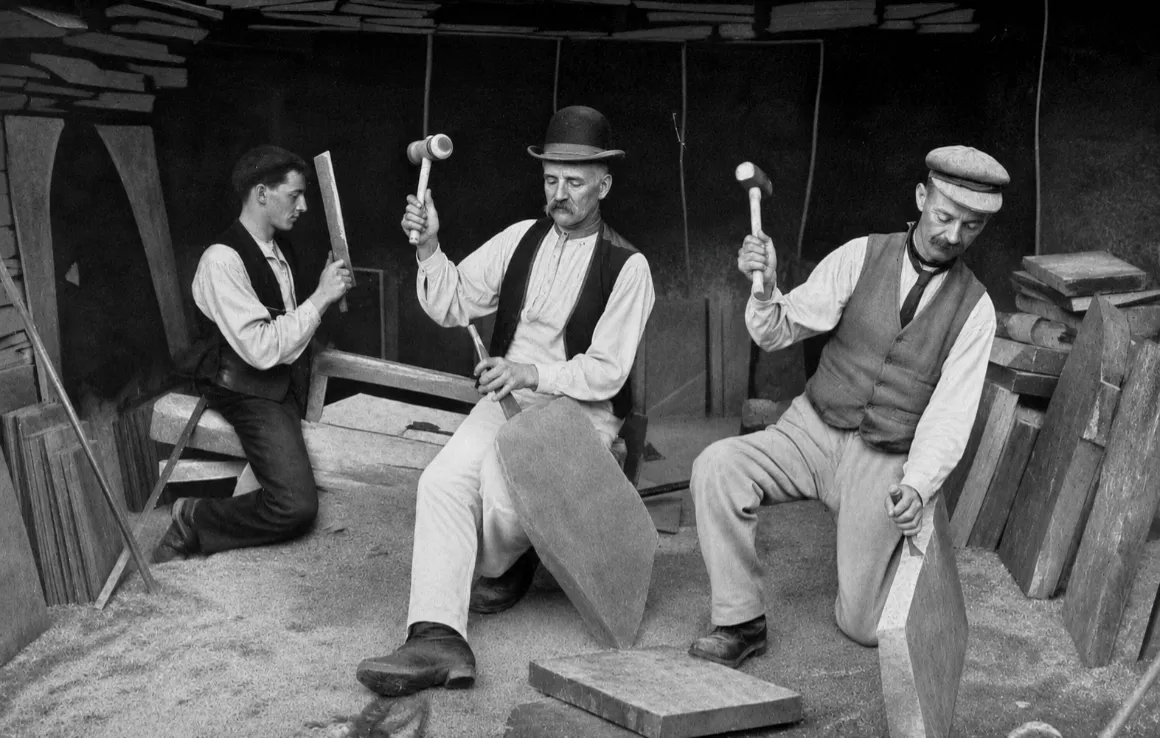
Splitting of the slate blocks with hammer and chisel to produce roofing slates requires great skill. Dinorwic Quarry [2]
The Chief Engineer was responsible for all aspects of engineering work within the quarry and for supervising the staff and attending to any correspondence, but it was the quarry owners who benefitted most from the work carried out. The Pennants of Penrhyn Quarry made vast amounts of money from slate quarrying. Their wealth, combined with profits made from their Jamaican sugar interests, enabled them to build the palatial family home, Penrhyn Castle – a far cry from the living conditions of their poorly paid workers.
Accommodation was provided for the employees in the form of barracks, which were usually situated on the hillside. Quarrymen worked a five and a half day week, from Monday morning to Saturday lunchtime, only returning home to their families for the weekend. In 1845, the average wage of a quarryman was the equivalent today of 75p per week.
The barracks didn’t have the comfort of their own homes but boasted a living room and bedroom, sparsely equipped with furniture made by the men’s own hands. They ripped up sacking to act as rugs and used brown paper to black out the windows. Their only means of light would be a paraffin lamp or candle, and no running water meant the use of a nearby freshwater brook or a standpipe for cooking and washing was essential. Poor diet, overcrowding and lack of sanitary facilities often led to diseases such as Tuberculosis, transmitted via airborne bacteria, or Silicosis, caused by inhaling the slate dust.
On some sites a Quarry Hospital was erected to deal with the inevitable casualties. The most common accidents were due to sudden rock falls and worn scaling ropes breaking.
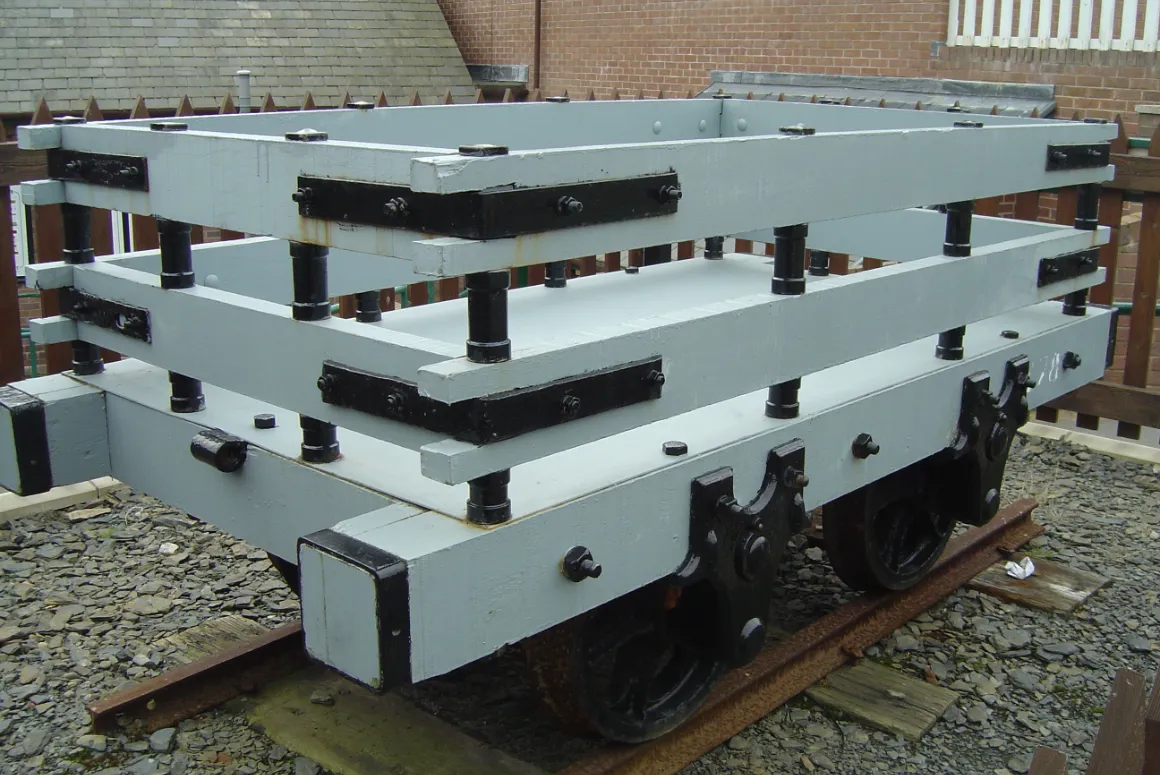
Slate wagon on Talyllyn Railway [3]
Innovations and Improvements
The need to improve techniques to speed up slate production was always on the quarry owner’s mind. During the 1850s, the owner of Llechwedd Quarry, John W. Greaves, designed his own sawing table, using waterpower to help split the slate into manageable pieces, and a slate-dressing machine, enabling the workers to trim the slate for use as roof tiles. It was here, too, that electricity was first installed, in place of candles, in 1890.
Steam power had initially been introduced at Hafodlas Quarry in 1807 to keep the works free of water, but it took a number of years before this method was fully accepted. Water wheels were the main source of power in many areas, although it was not unusual to see a windmill used to provide the energy to drive the equipment.
The skills of these men literally helped shape the face of Wales. They made their mark on the countryside as they chiselled out the slate which would ultimately roof the houses of properties and create the headstones of the deceased around the world.
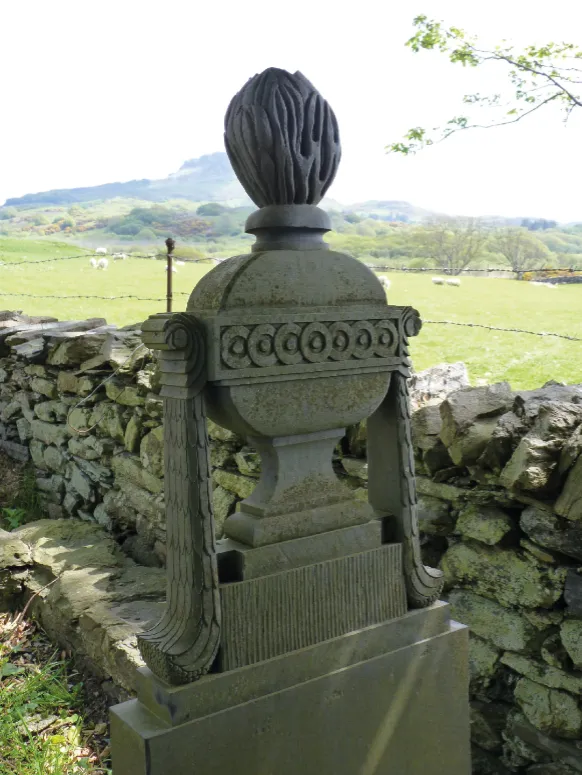
Example of elaborately carved slate headstone [4]
Slate Mining Terms
Bodiau Llwyd: ‘Grey thumbprints’ – a fault, in the shape of a thumb mark, rendering the slate inadequate for roof tiles.
Chwarel: Quarry
Cowjian: A chisel used for slate block-splitting.
Cyffell: Long, wide knife used for trimming roof slates to size.
Llechi: Slates
Rhys: Large mallet used to break up slate blocks.
Words: Karen Foy
Image attributes:
Feature image: Remains of slate workings, Blaenau Ffestiniog: Karen Foy
[1] St Cynhaearn Church nr Pentrefelin, Porthmadog: Karen Foy
[2] Splitting of the slate blocks, Dinorwic Quarry: Unknown author – Scanned by Rhion Pritchard 01/09/2006 from “Dinorwic Slate Quarries, Portdinorwic” an album of photographs published by the Dinorwic Quarry Co. c. 1910, (Restored), Public Domain, Source
[3] Slate wagon on Talyllyn Railway: Voice of Clam, Public Domain, Source
[4] Example of elaborately carved slate headstone: Karen Foy