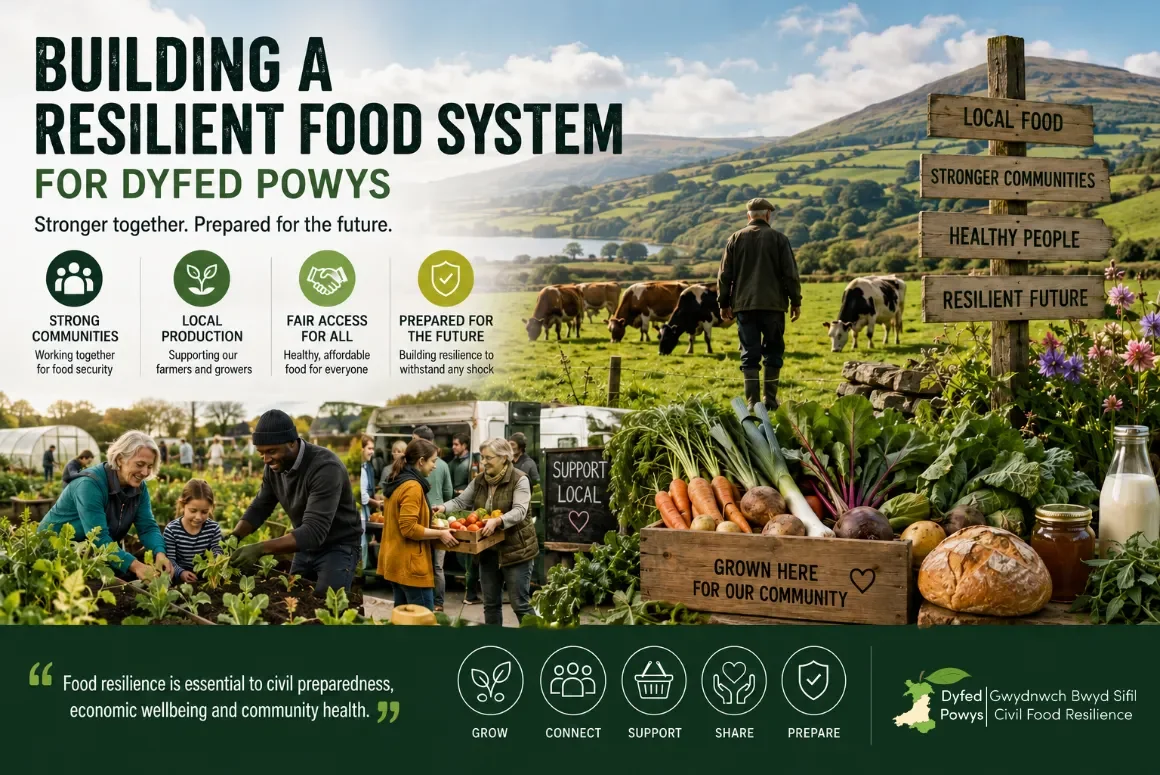
A new report, commissioned by the Local Food Partnerships of Dyfed Powys and led by Bwyd Powys Food hosted by Cultivate has been published highlighting the fragility of our food supply. ‘Civil Food Resilience Dyfed Powys’, provides a robust evidence base and practical insights to inform a future Food Resilience Strategy for the region. The report highlights the critical need for civil preparedness against intensifying risks, including extreme weather events, geopolitical instability, energy price volatility, and cost-of-living pressures, as well as improving longer-term food system resilience.
The report confirms that while Dyfed Powys possesses considerable strength in agricultural production—particularly cereals, meat, dairy, and eggs—vulnerabilities are substantial. Specifically:
- Insufficient local horticulture to meet population demand: Despite occupying 56% of Wales’ total agricultural land, only 5% of agricultural land in Dyfed Powys is dedicated to crops and horticulture.
- Significant affordability pressures on low-income households: 36% of small areas across Dyfed Powys are in the most deprived 10% in Wales regarding access to services.
- Minimal emergency food planning: At the time of the research, zero councils across the region had published specific emergency food plans.
- Supply chains: Less than 5% of agricultural produce produced within Dyfed Powys is consumed by the local population.
To build a resilient food system capable of withstanding future shocks, the report outlines clear recommendations and strategic actions required across all levels of society.
Clear Actions for a Resilient Food System
The research – led by Miller Research and the Innovation Lab at Centre for Alternative Technology
(CAT) – combined desk research and interviews with a participatory workshop approach. The Dyfed
Powys Civil Food Resilience Lab brought together over 80 actors from across the food system to
explore a range of food shock scenarios and responses. The following recommendations are drawn from the report’s eight key delivery areas and are segmented by actor:
For Individuals and Households
- Upskill in Food Management: Build skills in cooking with affordable, seasonal staples and locally sourced produce. Learn to use leftovers creatively to reduce waste.
- Strengthen Social Networks: Talk about food resilience with friends and family. Participate in community events and get to know your neighbours.
- Grow Food: Grow food at home where possible to build self-reliance and practical knowledge.
- Get involved with your Local Food Partnership: Local Food Partnerships are leading this work. There is one in each Local Authority (Powys – Bwyd Powys Food, Carmarthenshire – Bwyd Sir Gâr Food Partnership, Ceredigion – Partneriaeth Bwyd Ceredigion, Pembrokeshire – Pembrokeshire Food Partnership). Sign their food charters, sign up to newsletters, follow their social media pages or get in touch with their coordinators for more information.
For Communities and Local Organisations
- Build Relationships: Use food as an inclusive way to bring people together across boundaries and get to know the ‘faces behind the food’.
- Support Local Production: Open community farms and gardens to expand local production. Fund staff to support these community growing projects.
For Regional Organisations (e.g., Local Authorities, Local Resilience Forums, Public Services Boards)
- Establish Governance: Begin to prepare a regional governance mechanism for food resilience with clear roles, defined responsibilities, and links to Local Resilience Forums (LRFs) and Public Services Boards (PSBs).
- Develop Infrastructure: Establish county farms as hubs for horticulture, processing, storage, and distribution to strengthen local supply.
- Leverage Procurement: Set public body targets for local procurement and support creation of local co-ops and public membership schemes to provide predictable income for growers.
- Prioritise Vulnerable Groups: Collating relevant information and safely sharing it with trusted community partners to support the identification of vulnerable people.
For National Bodies (e.g., Welsh Government)
- Invest in Supply Chains: Provide financial and regulatory support, including grants, loans, and tax incentives, to secure an economic basis for growing and fund infrastructure for long-term resilience.
- Develop Emergency Planning: Consider preparing emergency legislation to guide national stockpile distribution and engage with national retailers to agree on criteria that would trigger rationing of key foods.
- Embed Food Literacy: Integrate food skills into school curricula, covering basics, batch cooking, and sustainable food systems.
- Fund Local Action: Fund Local Food Partnerships sufficiently and on long cycles (e.g., 5 years minimum) to empower local bodies to deliver services.
Richard Edwards, Chair of Bwyd Powys Food said:
“Food resilience is no longer optional – it is essential to civil preparedness, economic wellbeing and community health. Dyfed Powys has significant strengths: committed local actors, strong agricultural heritage, vibrant community networks and robust public procurement levers. With coordinated leadership, long-term investment and a commitment to inclusion, the region can build a food system capable of withstanding shocks.”
Tom Bajjada, Associate Director at Miller Research commented:
“This research shows that while Dyfed Powys has a strong agricultural base, resilience is not simply about how much food we produce. It is about whether the system as a whole can continue to function during disruption. What we found is a clear imbalance: we produce significant volumes, but rely heavily on external supply chains and face real challenges in ensuring people can access healthy, affordable food locally. The opportunity now is to build on the region’s strengths – its land, its communities and its partnerships – to create a more balanced, connected and prepared food system. That means investing in local infrastructure, strengthening coordination, and treating food as a core part of how we plan for resilience in the years ahead.”
Rachel Tuckett, Innovation Lab Manager at CAT, explained the importance of involving a wide range of people in the work.
“To create meaningful change, we need to enable the people who make up our regional food system to hold honest, open dialogue and explore risks and challenges together. The Dyfed Powys Civil Food Resilience Lab was powerful because it brought together actors from right across the supply chain and across all three sectors, to understand each other’s perspectives and co-create practical responses. The sense of agency and momentum at the end of it was palpable.”
The resultant report provides a shared vision and practical pathways that reflect the lived experience and expertise of communities across Dyfed Powys. The Local Food Partnerships are leading the next phase of work to support scaling up awareness across the Dyfed Powys area. For more information and to read the reports, visit our website.