How North Wales’ damp climate, steep hills, and centuries of sheep grazing have preserved a globally important stronghold for mushrooms
Walk across an unimproved sheep pasture in North Wales on a cool, damp October morning and you might just stumble across something extraordinary: a scatter of mushrooms in scarlet, jet black, buttercup yellow, and pale, waxy pink, tiny flashes of colour in an otherwise unremarkable field.
You may be even more surprised to learn that beneath your feet lies one of the world’s richest habitats for grassland fungi. The old, unploughed pastures of the UK – and Wales in particular – are the global equivalent of tropical rainforests for these species, each mushroom appearing as the temporary fruit of a vast and invisible underground network, known as mycelium, which will have been living quietly under that Welsh sheep pasture for decades, perhaps even centuries.
Among mycologists – scientists who study fungi – Wales has a serious reputation.
Why Wales Does So Well for Fungi
The reasons come down to climate, and land use. Traditionally, Wales has a wet, mild, oceanic climate, providing the right conditions for the fungi to fruit reliably and abundantly. But historical land management is just as important. Since the mid-twentieth century, much of lowland Britain has been ploughed, drained, and fertilised to increase grass growth for livestock. This kind of intensive management is disastrous for fungi, which thrive in long-established, nutrient-poor soils that have remained largely undisturbed.
Much of Wales escaped this fate because its grasslands are too steep, too wet, or too remote to be ploughed. Instead, they have been grazed by sheep, keeping the vegetation short while leaving the underlying soil intact. The result is a remarkable extent of semi-natural grassland, perfect habitat for the fungi to flourish.
Despite its small size, Wales accounts for approximately 27% of all records within the Fungal Records Database of Britain and Ireland for a group of fungi known by the acronym ‘CHEGD’: Clavarioids (club, coral, and spindle fungi), Hygrocybe (waxcaps), Entoloma (pinkgills), Geoglossum (earthtongues) and Dermoloma (crazed caps). Collectively, these groups are used by ecologists as indicators of high-quality, ancient grassland, much as certain wildflowers indicate an unimproved meadow. When researchers ranked the twenty best sites in the British Isles for grassland fungal diversity, Welsh sites made up the majority of the list.

Clavaria zollingeri [1]
The Waxcap Story
Of these groups, waxcaps are perhaps the most charismatic ambassadors for Wales’ grasslands. These small, glossy, brightly coloured mushrooms are greasy or waxy to the touch as the name suggests, and their presence is essentially a certificate of ecological quality. If you find a good range of waxcap species in a field, it is a strong indication that the land has escaped intensive cultivation and fertilisation, possibly for hundreds of years.
Interestingly, some of the best sites for them aren’t nature reserves at all, but churchyards and cemeteries, sometimes referred to by mycologists as ‘waxcap lawns’ – small islands of undisturbed ground protected by tradition rather than conservation policy. More broadly, the richness of Welsh grasslands was highlighted by a 2013 survey of 48 sites across Wales, which recorded 111 species from the CHEGD group, including one species previously unknown to science and fourteen new records for Wales, two of them new to the UK.
In North Wales, Wildlife Trust reserves such as Eithinog, near Bangor and Aberduna, near Mold are famous hotspots where these exact clusters appear every October. They have each recorded around 20 species of waxcap, with names such as scarlet waxcap, parrot waxcap (a vivid green), snowy waxcap, and honey waxcap.

Hygrocybe psittacina (Parrot waxcap) [2]
The Strange and the Scarce
One of the great pleasures of fungi hunting is that you are never sure what is going to turn up. North Wales has produced some genuinely rare discoveries, including the violet coral fungus, a species so unusual in appearance that it was compared to a piece of tropical coral reef transplanted to a Welsh field.
Even more elusive is Lepiota grangei, a small, poisonous mushroom with a distinctive green-blue, scaly cap. It has been confirmed in Wales only twice in the past two decades: once in Ynys Môn (Anglesey) in 2004, and once at Bannau Brycheiniog (Brecon Beacons) in 2012.
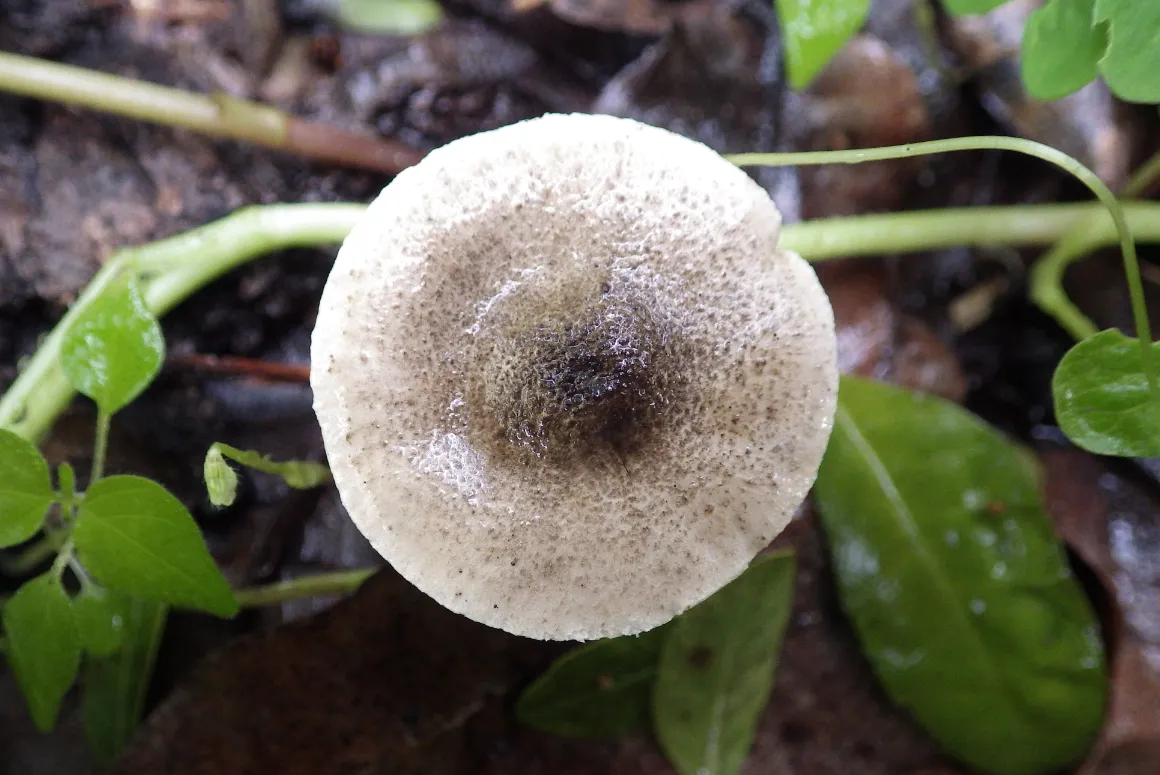
Lepiota grangei [3]
Woodland Stars
The surprises are not confined to grassland. North Wales’ oak and birch woods, damp ‘Celtic rainforest’ habitats and extensive conifer plantations are excellent territory for woodland fungi. Penny bun, better known to cooks as porcini or cep, can be found in real abundance in local woods. Fly agaric (featured image), the classic red-and-white toadstool of storybooks, is common wherever birch grows. In conifer plantations, the yellow stagshorn – a small, coral-like jelly fungus – is among the first species to appear each September, a signal that the season has properly begun.
Venture into one of North Wales’ woodland reserves and the species list continues. Sites such as Ddol Uchaf near Caerwys and Nantporth near Bangor reward closer inspection: many of the finest discoveries are tiny and easy to walk past, hidden among leaf litter or clinging to rotting wood.

Yellow Stagshorn [4]
Where and How to See Them
Autumn is by far the best season for mushroom hunting, particularly when a spell of dry weather is broken by heavy rain and a sudden drop in temperature, conditions that can trigger fungi into fruiting.
North Wales Wildlife Trust runs guided fungus forays throughout the season, and joining one is easily the most rewarding way to learn how much there is to discover. An experienced guide can help you identify what you’ve found, point out species you might otherwise walk straight past, and explain the subtle clues that reveal where fungi are most likely to be hiding.

Geoglossum glutinosum [5]
One strict rule applies wherever you go: never eat anything you find unless you are 100% certain of its identity. Alongside some of the country’s finest edible species, Wales’ woods and fields also host some of its most poisonous, with names as startling as their effects: the sickener, poison pie, death cap, and the destroying angel. Even with an expert on hand, identification can be difficult, particularly with unfamiliar species. The safest approach is to leave mushrooms exactly where they are so others can enjoy them too – and take a photograph home instead.
You won’t find any signposts for this. No car park, no viewpoint, no waymarked trail or visitor centre – just an open field, an ancient churchyard, perhaps a decaying log at the bottom of a garden. Fungi grow in every habitat, and you don’t need to go far to find them. But look closely, and you’ll find a world as curious and vivid as any coral reef, thriving quietly under a Welsh sky.
North Wales’ mountains draw the eye upward. Its fungi invite you to look down – to the small, the strange, and the wonderful.
Words: Sonia Goulding
Image attributes:
Feature image: Fly Agaric
[1] Clavaria zollingeri by Dan Molter (shroomydan) at Mushroom Observer, a source for mycological images. You can contact this user here. – This image is Image Number 90973 at Mushroom Observer, a source for mycological images. CC BY-SA 3.0, Source
[2] Hygrocybe psittacina (Parrot waxcap) by Dan Molter (shroomydan) – This image is Image Number 54530 at Mushroom Observer, a source for mycological images. CC BY-SA 3.0, Source
[3] Lepiota grangei by zaca at Mushroom Observer, a source for mycological images.You can contact this user here. – This image is Image Number 577649 at Mushroom Observer, a source for mycological images. CC BY-SA 3.0, Source
[4] Calocera viscosa (Yellow stagshorn) – Adobe Stock (Free), Source
[5] Geoglossum glutinosum by Irene Andersson (irenea) at Mushroom Observer, a source for mycological images.You can contact this user here. – This image is Image Number 192121 at Mushroom Observer, a source for mycological images. CC BY-SA 3.0, Source