Unique mouthguard, MRI and computational data offer first insights on long-term effects of head impacts in women’s rugby
The most advanced study to investigate the impact of contact sports on the brains of female athletes is being carried out by Cardiff University researchers.
Academics from the Schools of Engineering, Psychology and Dentistry are working with the University’s Women’s Rugby Football Club (CUWRFC) to deliver the very first assessment of the long-term risks associated with female contact sport.
Combining data from instrumented mouthguards – used to record the frequency and magnitude of head impacts – with advanced magnetic resonance imaging (MRI), magnetic resonance elastography (MRE) and computer simulations, it is hoped the findings will bridge a gender gap in sports science research.
For back row forward Cleo Pallister-Turley, 21, who is in the final year of her Biosciences degree, the study is long overdue.
She started playing aged seven and by the time she ran out for the under 9s team, when contact started, she was the only girl in her local Devon side – Sidmouth Rugby Club.
“Head health was spoken about, but not on the level that I think it should have been,” she explains.
“Especially if you’re starting out at a very young age and taking those hits; we start contact at under 9 when so much brain development is going on. The amount it was talked about was not great considering the damage it can do.”
Cleo also remembers concussion being a worry for her mum Louise, despite her first aid training.
“I took a few concussions in my under 15s season, which made mum so nervous,” she said.
“So, I think from a parent’s perspective as well, not understanding the danger you’re allowing your child to put themselves in was something she struggled with and probably still struggles with.”
Legal implications
The study is running at the same time as an ongoing court case against rugby’s governing bodies by more than 1,100 former players.
Drawn from both professional and amateur levels of the game and across union and league codes, the group of predominantly male athletes allege the governing bodies were negligent in failing to take reasonable action to protect them from the risks of long-term neurological conditions.
Many of the claimants have since developed symptoms and received diagnoses of early onset dementia, Parkinson’s, epilepsy and motor neurone disease, which they say are linked to repeated head impacts accumulated throughout their sporting lives.
“We have to have the same research as the men to be able to fully understand the risks,” argues Law student Ffion James, 21, another back row forward in Cardiff women’s first team.
“If the research is there, more people will confidently step onto the field.”
Like teammate Cleo, Ffion started playing rugby aged eight alongside her twin sister Celyn in a team full of boys.
“My father was the coach, so he threw us into the game. I remember feeling like a bit of an imposter because me and my sister were the only girls playing. But I liked it. It made me feel powerful.”
Ffion took a break from the game to pursue ambitions in dance before joining CUWRFC at university.
“I started playing again when I got to university. But to tell you the truth we didn’t really know much about head injuries.
“I’ve played so many games for the university now and this year is the first year where if I get a knock to the head, it actually feels serious. Before that, if I got a knock on the head, I would get straight back up and think it would be fine and just keep going. But now, I take it more seriously.”
Evidence-based safety
The academic team says their findings will be vital in shaping evidence-based, gender-specific safety protocols.
Project lead Dr Peter Theobald of the School of Engineering said the study would also be key in defining female thresholds for head injury assessments (HIAs) in rugby and other sports.
“While contact sports have already been linked to brain disease through post-mortem studies of elite male athletes, no similar research has ever been conducted in women – despite evidence that the female brain may be more vulnerable to injury,” he explains.
“With participation in women’s sport growing rapidly across the UK, gender-specific studies like ours are urgently needed to inform future policy, safety guidance and sporting protocols.”
His aim is for their innovative methods to accelerate the time taken to understand the consequence of repeated head impacts:
“We don’t want women players today having to wait 20 years to find they are at greater or equivalent risk to male players.”
The research team has previously demonstrated extensive microstructural brain changes in male participants after performing just ten routine football headers – effects that persisted for more than six months. This was identified using the Connectom MRI scanner at Cardiff University’s Brain Research Imaging Centre (CUBRIC), one of a few such powerful machines worldwide that enables detailed investigation of brain microstructure.

Now, they are employing even more advanced technology to focus on athletes from CUWRFC, who compete in the UK’s top tier of university rugby – Women’s BUCS Super Rugby.
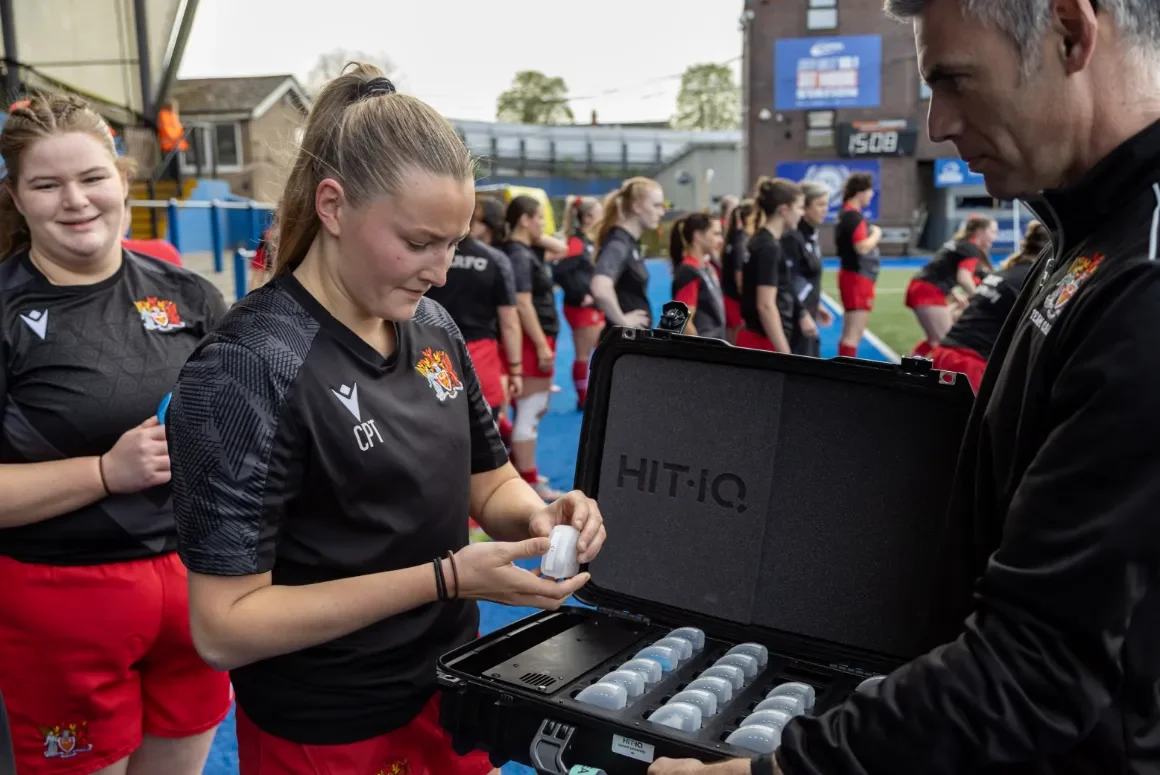
The group of 30 players has been equipped with instrumented mouthguards supplied by HIT IQ, so that the magnitude and frequency of head impacts they experience across every game of the 2025/26 season can be tracked.
A subset of five players is also undergoing multiple, advanced MRI scans, allowing researchers to record any evolving changes in brain structure and stiffness.
Dr Megan Barnes-Wood, a PhD researcher based at the Medical Experiment, Design and Computational Laboratory at Cardiff University, will also leverage these data in combination with the mouthguard outputs to computationally estimate each player’s in-game brain deformation – a world-first.
The team ultimately aims to predict risk in women players, initially by comparing their results to data in elite male rugby, which is already known to cause an increased risk of brain injury.
A focus on the welfare of female athletes
This study is part of a wider commitment by the research team to address the disparity in sports-related research focused on women.
PhD researcher Freya Butcher, sponsored by local company SPORTTAPE, is investigating the impact of menstrual health on welfare and performance in female athletes as part of her doctoral study at the School of Engineering.
A trained physiotherapist, Freya also brings her expertise to the head health study where she is responsible for carrying out pitch-side clinical assessments on the players using the internationally recognised SCAT-6 protocol.

She said:
“Historically within sports science, we know only 6% of the research is focused entirely on female athletes. So, we’ve made a conscious effort here to study female athletes only, which I think is really important in tackling that gap in understanding.
“For me, it comes down to treating athletes as individuals. It’s unacceptable for protocols like the head injury assessment in rugby to be based on data from male athletes and then – seemingly – just lowered slightly for their female counterparts.
“Our study is trying to change that, and we’ve had a great response from the team who have been telling us this is a good thing because they feel safer and it is reassuring that someone cares about them and cares about their wellbeing enough to investigate it.”
The researchers have seen first-hand the cultural, physical and psychological benefits that rugby has to offer, having spent the last eight months with the women’s team.
They say their work on performance and wellbeing in the women’s game is central to these outcomes because it will enable players to make informed decisions about their participation.
“Our ultimate ambition is that in ten years’ time we are in a situation where the game of women’s rugby is still growing,” says Dr Theobald.
“What we want to understand is quite what the risks look like so that people can enter the game with a clear picture of what they are letting themselves in for.”
Cleo adds:
“There are so many barriers to female participation in rugby.
“So, even if one more girl steps onto the pitch, or one more parent feels comfortable letting their daughter play because they feel like there is good sports research that has been done about it, then that’s a win for me.”