Karen Foy looks at the work of Thomas Telford one of Britain’s most talented engineers and two of his iconic achievements which remain as important landmarks, spanning the waterways of north Wales.
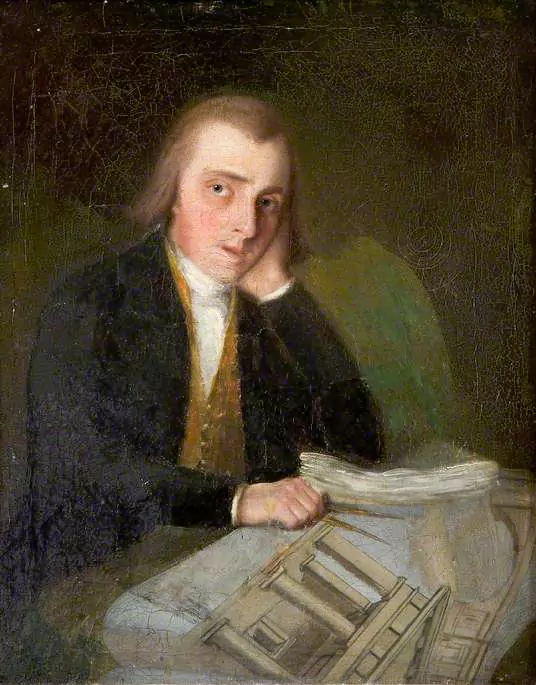
Born on the 9th August 1757 in Dumfries, Scotland, Thomas Telford was the son of John Telford, a shepherd and his wife, Janet. His early career began as an apprentice stonemason in Langholm and after a short spell in Edinburgh he moved to London where he was appointed Master Mason overseeing construction of building additions to Somerset House. Here, he worked alongside other architects including, Sir William Chambers and the talented Robert Adam.
It wasn’t long before Telford had developed substantial engineering skills and after managing the construction work on Portsmouth Docks, he spent time in Shropshire, renovating Shrewsbury Castle and the nearby prison.
Clocking up vital experience, his trips to Scotland saw him contribute to the building of the town of Ullapool. Many piers and harbours benefited from his growing knowledge and expertise, but after returning to Shropshire, and the difficult task of building the Ellesmere Canal, Telford decided to focus his attention on north Wales.
In 1811, to help improve communication and trade between the capital and Ireland, Telford approached Parliament with a plan to build a road between London and Holyhead. The intention was to overcome the most difficult aspects of this route with the construction of two bridges – the Conwy and Menai Suspension Bridges.
The Conwy Connection
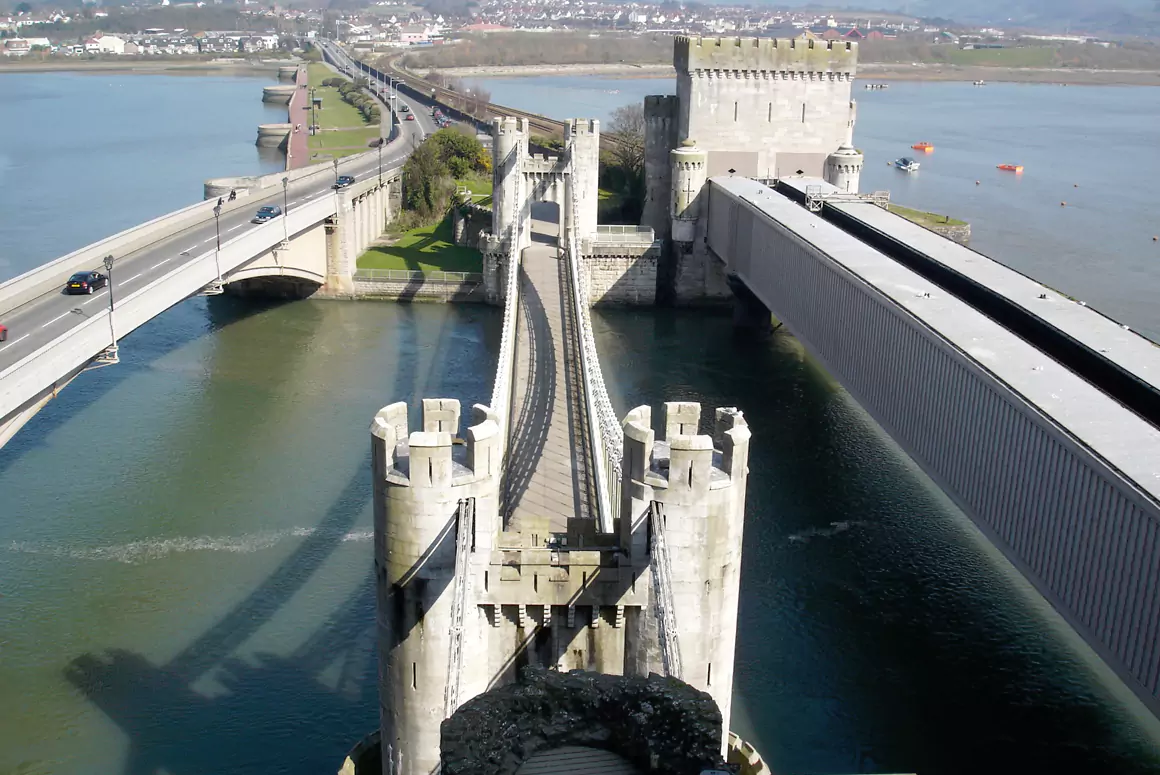
Built in the shadow of a 13th Century castle and ranking as one of the world’s first suspension bridges, Telford’s construction spanned the River Conwy connecting the walled town of Conwy to Deganwy. Replacing a ferry service which crossed the river at the same point, the bridge was eventually assembled in 1826 and designed so that the supporting towers, 3.75m in diameter and 12.2m high, could be built in the same style as the turrets of the adjacent castle. The original deck was thought to have been timber planks carried on a light framework, but this was replaced in 1896.
The bridge brought travel and trade to the Conwy Valley and until the erection of Robert Stephenson’s iron box railway bridge which ran alongside, the suspension bridge was the only means of crossing the river in a westward journey to Ireland.
In use until the 1950s, the bridge is now only passable on foot. Managed and maintained by The National Trust, this magnificent piece of engineering gives us a fascinating glimpse into the past and the restored Toll House, furnished in the style of the 1890s, shows us where every vehicle had to stop and pay sixpence before crossing.
The Final Link
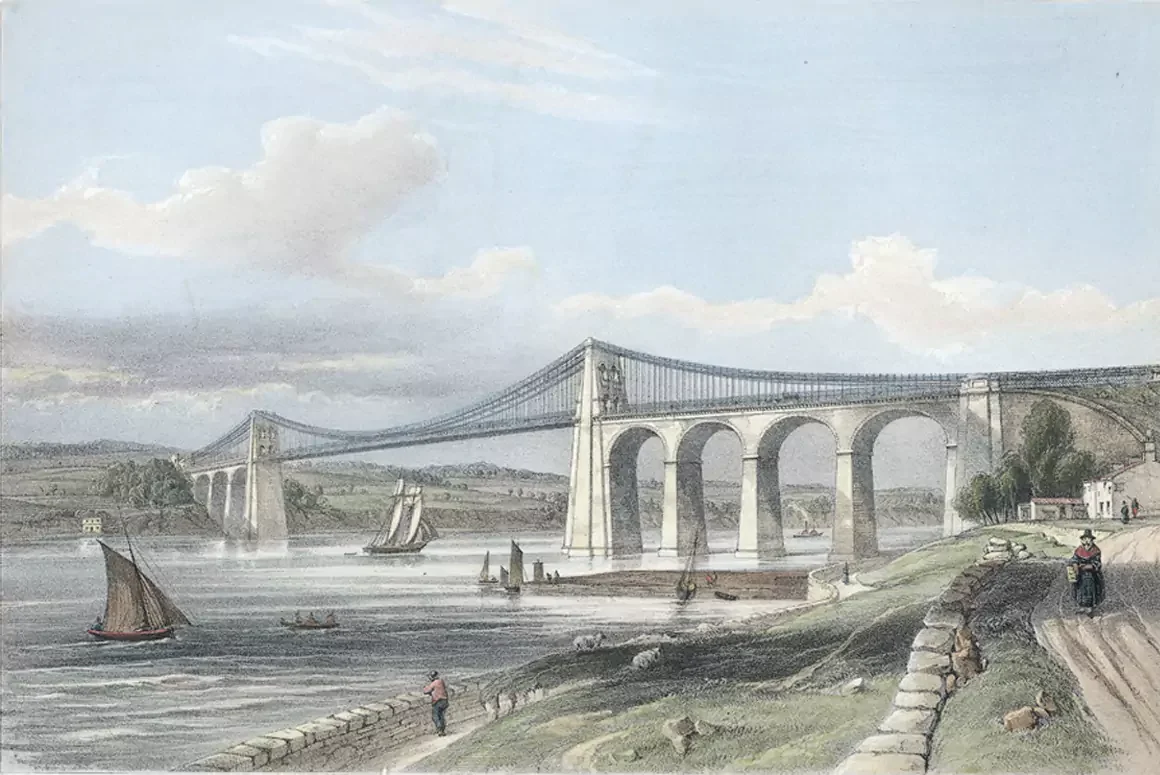
By the early 19th century, Holyhead was fast becoming one of Britain’s main links with Ireland. In order to complete the route from London to Dublin, an integral part of Telford’s plan was to provide a smooth transition between Anglesey and the mainland. Opened in the same year as the Conwy Bridge, the Menai Suspension Bridge, which would allow traffic to cross the Menai Straits, had to be tall enough to allow 100ft sailing ships to pass underneath at high tide.
With former colleagues, John Wilson, who supervised the masonry and resident engineer William Provis, who wrote a step by step account of every stage of the proceedings, work began in 1819 with the construction of the supporting concrete towers at either side of the bridge. Limestone was used to construct the arches, bought from the nearby quarries at Penmon and carried to the site by boat. Sixteen chain cables, made up of 935 iron bars were supplied by Hazeldean’s Foundry near Shrewsbury, prepared to order and soaked in linseed oil to prevent them from rusting.
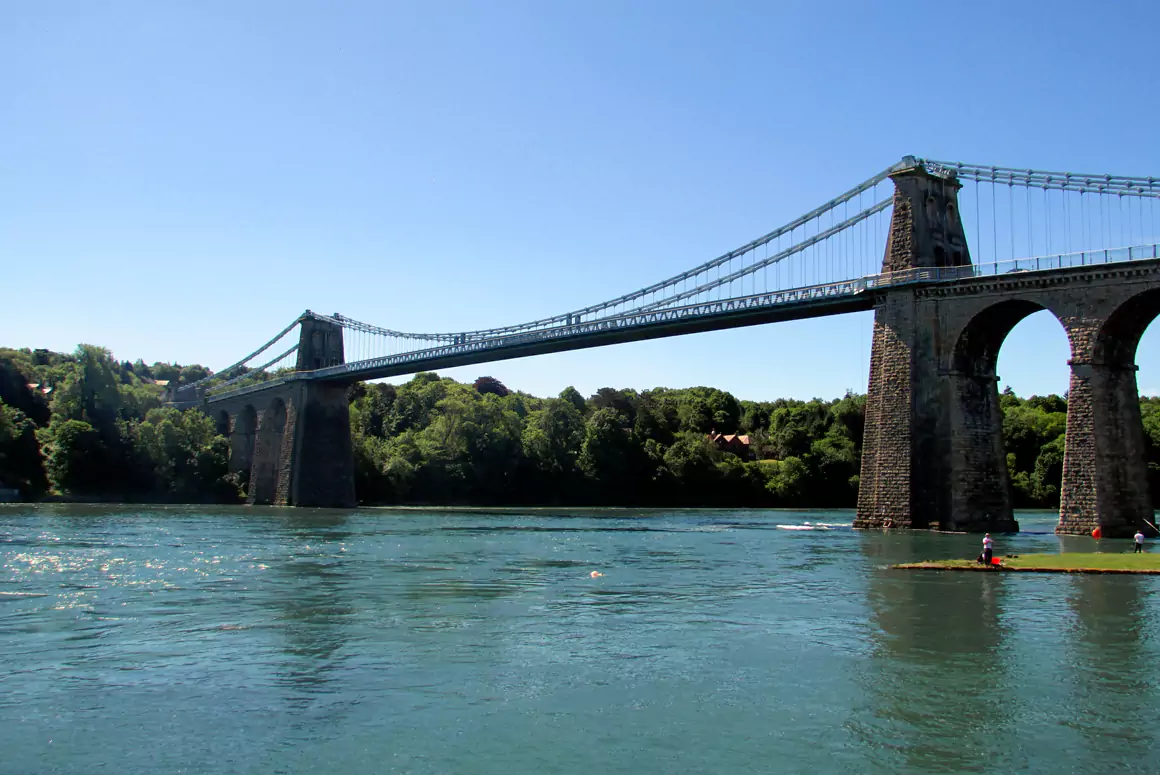
Although the stone work was finished by 1824, the raising of the chains took considerably longer and when they were finally hoisted into position, a drum band was commissioned to encourage the 150 workers in the heavy lifting involved with this mammoth task.
On the 30th January 1826, the bridge was officially opened to the public providing a reduction of nine hours on what had previously been a 36 hour journey from London to Holyhead. Cannons were fired at intervals to mark the occasion and a band played throughout the celebrations; within days the event was regaled in the pages of the local newspaper.
Dated the 3rd February 1826, the Chester Chronicle described that the Mail Coach, loaded with many of the inspectors and head contractors who had helped with the project, was one of the first vehicles to cross the bridge. Reported to have taken place at 1.30am, and lit by a blaze of lanterns, this initial trip was accompanied by cheers and cries of success. Later in the morning Thomas Telford, along with the Commissioner Sir Henry Parnell, is said to have travelled the route across, before other horse drawn carriages, including a cart from The Amlwch Brewery Company, followed throughout the day.
As a means of recuperating some of the money from the project, Telford had Toll Houses built which required travellers to stop and pay a fee before crossing the bridge. Erected at five mile intervals between the bridge and Holyhead, these octagonal buildings are still visible today, with one particularly fine example standing at the cross roads in Llanfair P.G.
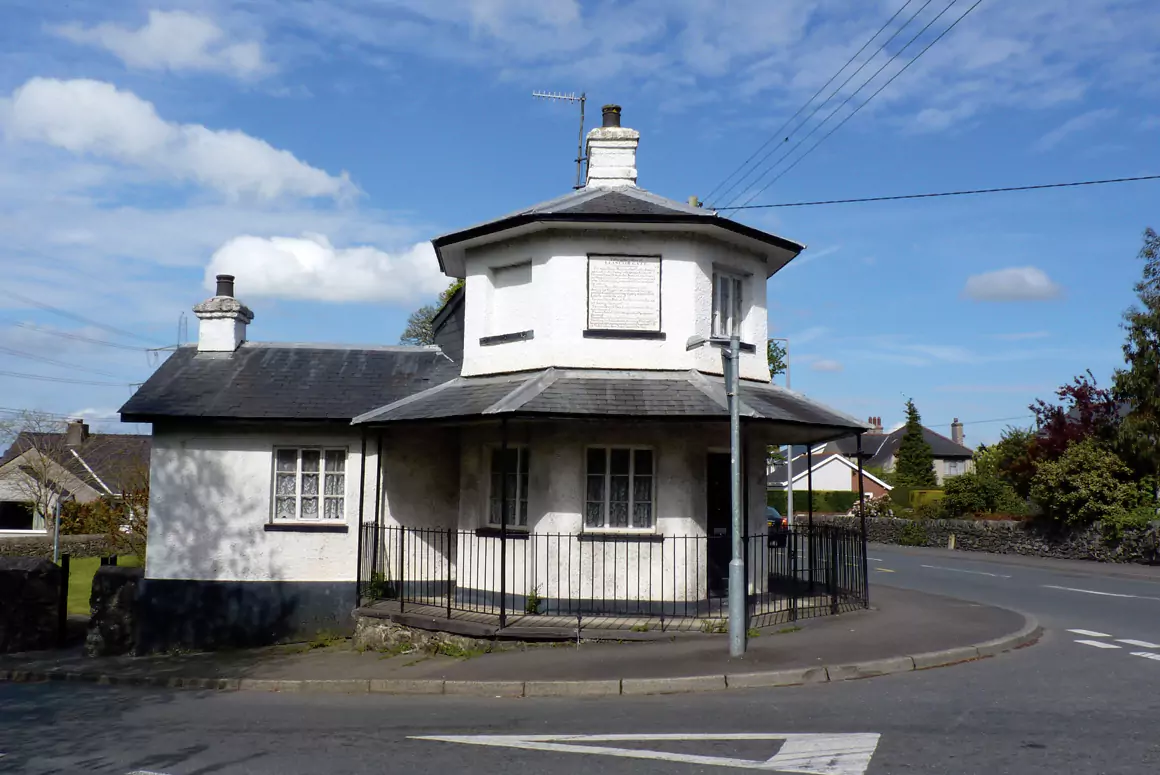
Coaches, carriages, carts and wagons were all charged a toll; even the Drovers of oxen, pigs, sheep and cattle had to pay for crossing on foot. Toll charges continued well into the 20th century before ceasing on the 31st December 1940.
In order to cope with the demands of today’s heavy freight traffic, the bridge has needed numerous face-lifts in recent years. The wooden road surface has been replaced with a steel deck, the iron chains have been exchanged for the hard wearing properties of steel, and in March 2005, the bridge received its first cosmetic makeover when the paintwork was stripped back to the bare metal to give it a completely new lease of life.
Now a World Heritage Site, the Menai Suspension Bridge is still a breathtaking sight, linking the mainland and Anglesey across the fast flowing Menai Straits below.
In 1871, such was the significance of this feat of engineering that the author Lewis Carroll (Charles Lutwidge Dodgson) mentioned the bridge in his classic children’s novel Alice through the Looking Glass:
White Knight says to Alice,
‘I heard him then, for I had just completed my design.
To keep the Menai Bridge from rust.
By boiling it in wine.
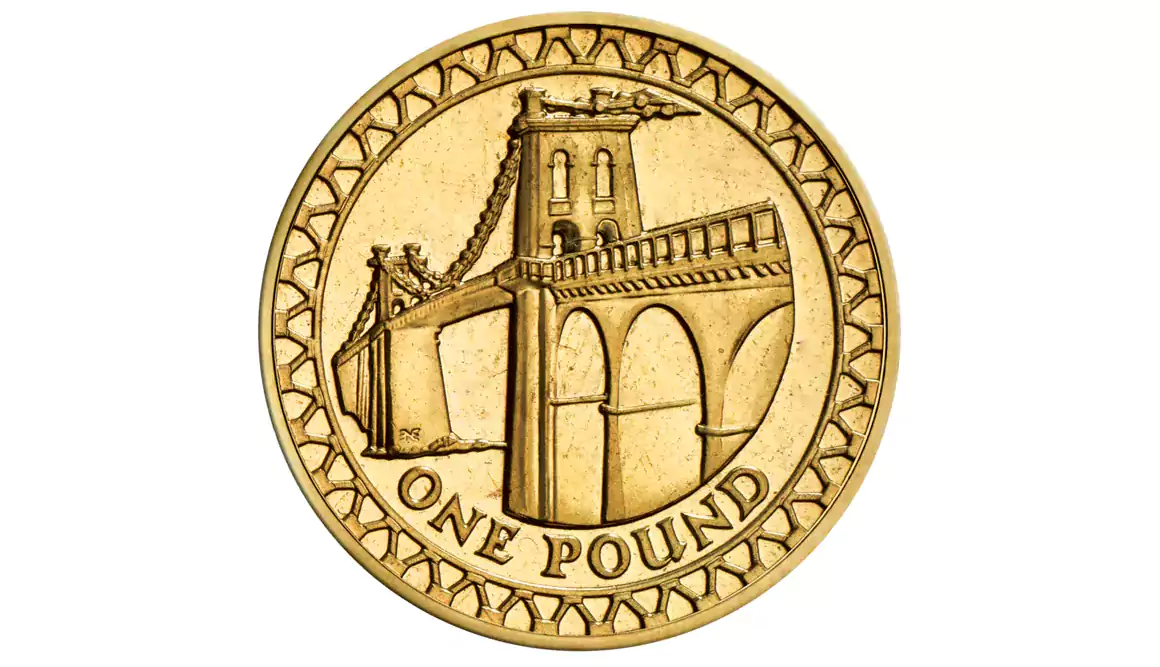
Recognition of Telford’s constructional endeavours continued in 1968 when an image of the bridge was chosen to be depicted on one of the Royal Mail stamp sets, followed by its use on the 2005 British one pound coin.
Thomas Telford’s accomplishments were not without risk. His bridges spanned unprecedented distances, yet forethought, constant testing and experimentation ensured that his bridges could withstand the high winds and strong tides that they might be exposed to. Telford’s engineering of the ‘Holyhead Road’ helped to change the face of Wales forever, and the construction of his suspension bridges provided a safer alternative to the dangerous ferry crossings of the past.
Words: Karen Foy
Image attributes:
Feature image – The suspension bridge, over the Menai, People’s Collection Wales, CAL, Source
Thomas Telford (1757–1834) Art UK , Public Domain, Source
Conwy Suspension Bridge, by Bencherlite, Public Domain, Source
The Menai Suspension Bridge, by Reading Tom, CC BY 2.0, Source
Toll House, Llanfair PG, Anglesey, Karen Foy
2005 Elizabeth II ‘Wales Menai Bridge’ £1 Coin, ©The Royal Mint, Source