This is now a pleasant open site providing about 5 acres of public open space. It incorporates 2 secluded woodland paths, both leading from Chatsworth Close down to the sea – one in an attractive dell following the banks of a stream to the Promenade.
The original much larger site was occupied by Penrhos College for Girls for over a century, before being demolished in 2001 when the current housing estate was built. For those that want to visit the main site lies between Ebberston Road East and Chatsworth Close, extended by the 2 attractive footpaths leading from Chatsworth Close down to the Promenade.
Map Reference: SH843795
But this site is much more and has a fascinating history including the Bacon & Ham division of the Ministry of Food during WWII
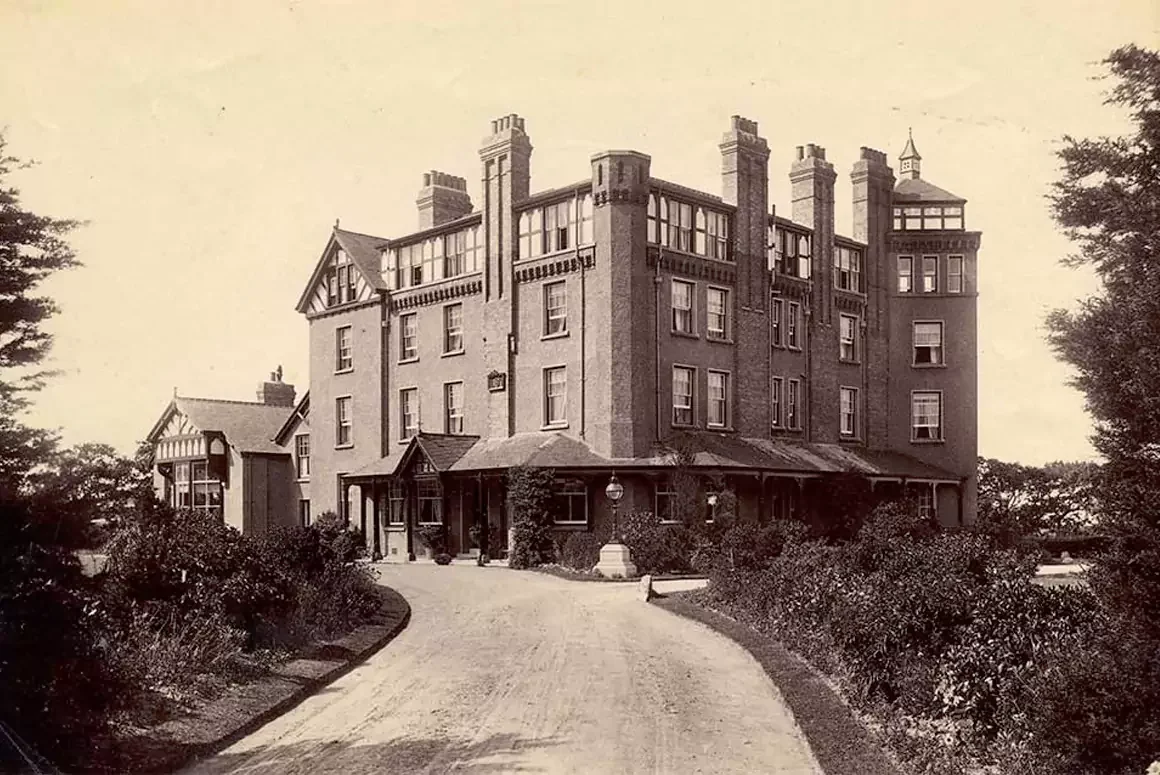
The overall site would have been open fields until 1882. In that year a “Hydropathic” Establishment was built on the westernmost part of the land owned by the Pwllycrochan Estate Company (formerly Lady Erskine’s estate, which covered most present day Colwyn Bay). Effectively this was an upmarket spa, boasting both Turkish Baths and also baths in hot and cold seawater!
Despite being housed in an extremely large and impressive building which commanded fine sea views, it was not commercially successful.
Penrhos College for Girls bought it in 1895 and moved the school there from its original site on the Promenade (in a Victorian villa called Gilbertville). The college gradually expanded their site westwards and in the early 1900’s bought considerable tracts of land from the Cayley Estate piecemeal, as the owner was in considerable financial difficulties at the time.
![Women packing bottles of cod liver oil into crates stamped with the words "Min. of Food Charged 10 shillings" [1]](https://www.welshcountry.co.uk/wp-content/uploads/2025/12/MinistryOfFood.webp "Penrhos College Colwyn Bay")
The college had a very successful history as a Methodist foundation for girls’ education. It expanded between the wars and thrived into the 1960’s. However changing times led to it merging with Rydal School for Boys in 1995 to form Rydal Penrhos and eventually all the pupils moved onto the Rydal site in Colwyn Bay.
The school had a very interesting history in the Second World War. The girls and staff were given 10 days to get out and the buildings were taken over by the Ministry of Food which had been evacuated from London and took over much of Colwyn Bay.
The school was evacuated to Chatsworth House, the stately home in Derbyshire and country seat of the Duke of Devonshire. Whilst this provided a very grand setting for the girl’s continuing education, it was also extremely cold for them in winter as the heating was very limited with war time rationing.
The school buildings now occupied by the Ministry of Food housed the Bacon and Ham Division, the Agricultural Planning Branch and also the Strategic Planning section. This latter was very important – it arranged and coordinated the immediate next day supplies of bread and milk to cities and towns after they had been bombed and lost their normal supply networks.
Today the site presents a much more peaceful appearance, with an attractive housing estate and impressive amount of linked open space for the community to enjoy and walk in.
The Penrhos College buildings were demolished in 2001 when the current housing estate was built. Several features from the former college have been retained, including the weather vane (overlooking the sea) and the top of the tower from the main school building (now located in the centre of the main site facing Ebberston Road East).
There is also a heritage display board on the main footpath through the site giving details of the history of the school.
As ever when looking at the history of any place there are anecdotes that relate to it and we could not resist adding this foot note about the local home guard.
The Home Guard
A benefit of the substantial recruitment into the Home Guard was the release of the army to perform its regular duty. Local men living in North Wales who for various reasons were unable to enlist in the services contributed by enrolling in the Home Guard.
There would be branches in every district, comprised of men perhaps too old for conscription. Originally named the Local Defence Volunteers (LDV), they were sometimes called ‘Look, Duck and Vanish’. Denbighshire was fortunate in having experienced men who had served in the First World War.
![The Home Guard [2]](https://www.welshcountry.co.uk/wp-content/uploads/2025/12/home-guard.webp "Penrhos College, Conwy Bay")
Lieutenant-Colonel John R.Williams was an example, and one of the first to join. He had joined the 4th Battalion, Royal Welch Fusiliers when the First World War broke out. Commissioned as a second lieutenant, he had served in Rouen, Messines, Passchendaele and Ypres. Others had fought in Flanders and in the Boer War. Williams transferred to the RAF in 1918 and became education officer of the squadron. After the war, he qualified as a solicitor.
Other local solicitors also joined the LDV on the outbreak of the Second World War. Major A. I. Edwards-Evans was organiser at Colwyn Bay, Captain Arthur Hughes was responsible for the enrolment in Colwyn Bay, J. D. H. Osborn was in charge at Betws-yn-Rhos and John Williams was lieutenant-colonel in charge of Abergele. His Home Guard regiment’s motto was Wastad yn Barod (Always Ready) and they tried to live up to it.
The Ministry of Food had its own Home Guard company, which became affectionately known as ‘Bureaucrats in Battledress’. There were strategically important defence positions – at the headland and the main line railway between Holyhead and Euston. Companies A, B, C, D and E, were set up to cover local geographic areas and when the Ministry of Food came, F company was formed under the command of Major Lawrence, until Lachlan MacLean, OBE, a principal assistant secretary arrived from
London in September. Many who arrived in July 1940 had been enrolled in the London guard in preceding months.
They were responsible for guarding a section of coastal defences A medical organisation within the Home Guard was authorised in April 1941, and a medical officer was appointed to each battalion with the rank of major. Dr Geoffrey Jones was with B Company and carried out the training.
A special feature of the procession to celebrate the third anniversary of the Ministry unit was a company of Women Home Guards from the Ministry of Food. They received a special ovation from the Colwyn Bay crowd. Miss A. E. French headed the company. It was highly unusual for women to be members of the Home Guard, as researched by Penny Summerville in her book Contesting Home Defence. But, there were career women in the workforce of the Ministry, who were also members of the Women’s Home Guard. They were not only employees but also the wives of the executive civil servants who had been evacuated to the town, and some local women had also volunteered. It is evident that Colwyn Bay was a progressive area in this field, clearly due to the influence of those evacuated civil servants.
Welsh Country would like to thank the Colwyn Bay Heritage Group for letting us publish excerpts from their fantastic collection of historic news of all aspects of Colwyn Bay. More details can be found on their website at colwynbayheritage.org.uk