
He could quite legitimately have said: ‘Come up and see my etchings’.
Augustus Edwin John (1878-1961) was a Welsh painter, Tenby born (4th January 1878), who studied at the Slade in London (1896-99) with elder sister Gwen, of whom more later, and in Paris, forging an early reputation because of his etchings (1900-14). ‘Come on up and I’ll show you my etchings’. They were two of four children born to Edwin John, a Welsh solicitor, and Augusta Smith, who apparently came from a Sussex family of master plumbers, and more importantly nurtured a love of drawing in the pair, that is until she sadly passed away when Augustus was just a sprat of six. Aged 17, he’d briefly frequent the Tenby School of Art before departing for London’s lights.
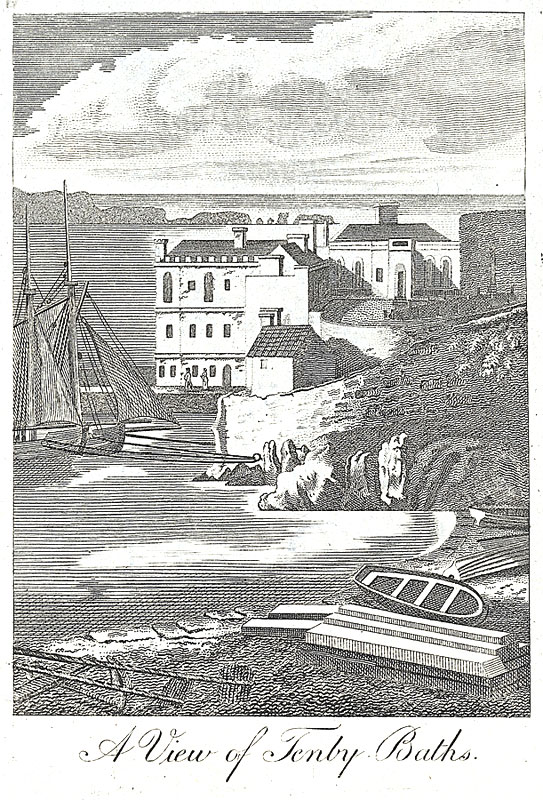
John was a talented draughtsman although just designing ‘stuff’ wasn’t really his forté. As fellow artist, writer and critic Percy Wyndham Lewis (1882-1957) remarked: ‘A great man of action into whose hands the fairies stuck a brush instead of a sword’. I guess as the pen is mightier than the sword, so is the brush in the right hands. Aged 19, he’d inflict a serious head injury on himself when diving into the sea at Tenby, whacking his nut on some rocks. We assume this did him no lasting damage, although the enforced convalescence appears to have worked in his favour, fast-tracking his love of art as he had time to indulge. The bearded bohemian look came after this too, so maybe the bang on the head launched him into eccentricity. Around 1910-12, Augustus and his mate, the mountain painter James Dickson Innes (1887-1914), painted in the Arenig Valley, Snowdonia
He certainly had a bit of the romantic about him as he luxuriated in such themes as gypsies, ‘fishing folk’, and beautiful ladies, especially those of a ‘wild, lovely, yet naturally regal’ countenance. Check out ‘Lyric Fantasy’ (1913). John’s portraiture of ladies is very individualistic. He’s not interested in portrayals of character, but hones in on ‘unique items of individual beauty or dignity’. There are plenty of examples featuring his own common-law wife, Dorothy (‘Dorelia’) McNeill (1881-1969). The 1923 picture of the Portuguese cellist, Guilhermina Suggia (1885-1950) is another fine example, as ‘Madame Suggia’ is captured in characteristic pose, bowing her cello like a scarlet-gowned Britannia or Boudicca. I fancy Augustus would have had a field day with my wife’s eyes; those I fell in love with. Augustus certainly painted ‘reality’ as he saw it: ‘Warts and all’ as Cromwell might have said. The end result could be cruelly honest though on occasion. One portrait of Montgomery of Alamein was rejected by the sitter as he reckoned it didn’t look like him.
John didn’t just paint the ladies and he was versatile enough to capture character too. He painted such luminaries as Irish playwright George Bernard Shaw (c.1914), Dorset novelist and poet Thomas Hardy (1923), T.E. Lawrence (of Arabia), Irish wordsmiths James Joyce and W.B. Yeats, and the heavy-drinking Welsh poet and writer, Dylan Thomas, one of whose pictures hangs in the National Museum Wales, as well as politicians David Lloyd George, Ramsay MacDonald and Winston Churchill. Although John had informality and spontaneity coursing through his Welsh veins, he could also settle to a formal subject, the best example of which is his ‘Judge Dowdall as Lord Mayor of Liverpool’ (1908-09), which is Edwardian ‘strike a pose’ at its best. The gent in question was the Rt. Hon. Harold Chaloner Dowdall (1865-1955) who’s depicted with his sword bearer.
I gather John could get rather excited about murals, which led to him being described as ‘Jimson-like’, which refers to Gulley Jimson, the fictional artist conjured up by Joyce Cary (1888-1957), the Irish-born novelist, who has a penchant for murals and behaving dishonourably in Cary’s 1944 work ‘The Horse’s Mouth’. It has even been claimed that Jimson may have been based on John. There are certainly similarities. Jimson is a lone star, rebellious and bohemian. If he sees a blank wall he wants to transform it. Augustus John was similarly transformative and innovative. As a WW1 war artist, John had a design for a Canadian War Memorial mural that never translated to full-size reality, and was very nearly court-martialled after getting himself into a brawl. We do have his ‘Galway’ (1916), however, the largest mural artwork that he was able to produce, which I believe is getting on for 40 feet by 10. He didn’t even have a commission for it apparently but decided to crack on with something when he was staying in Galway City on Ireland’s west coast. He wanted to produce something on a vast scale and did, bringing out the best of the place as he saw it. ‘Galway’ can be viewed in the Tate.
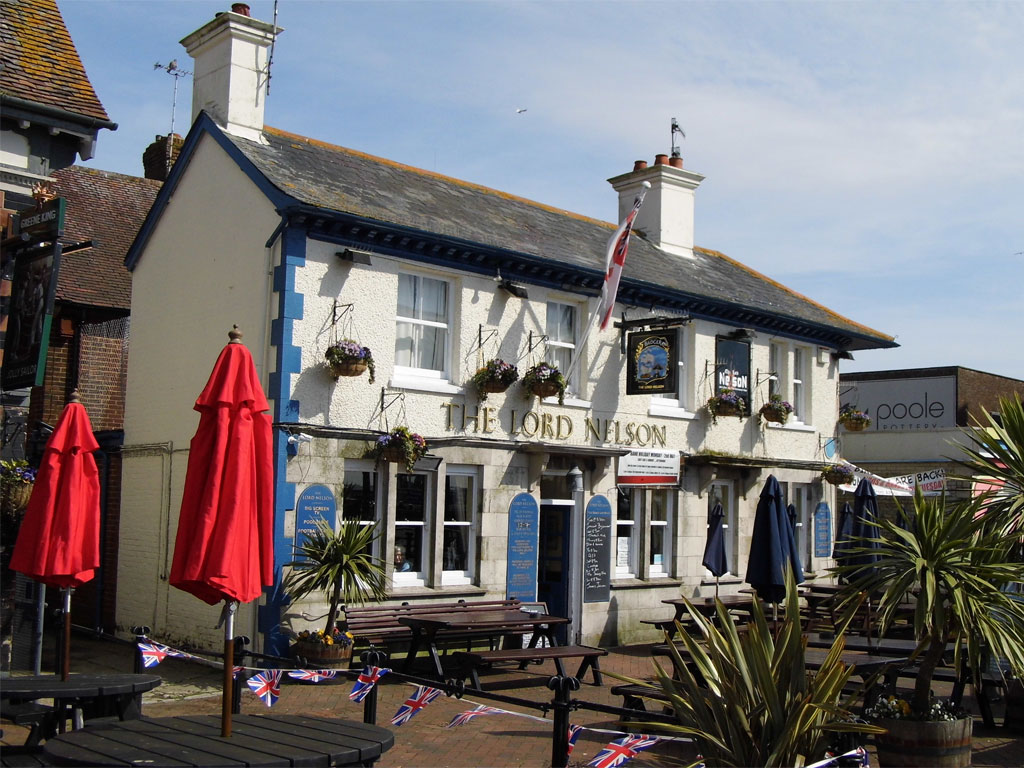
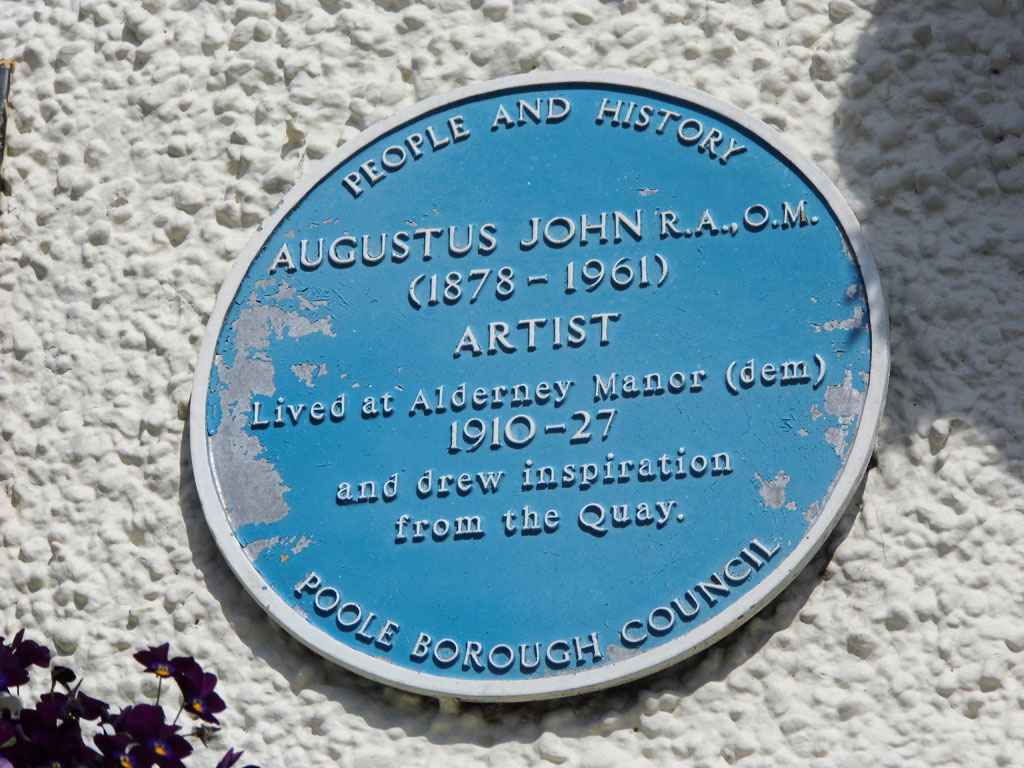
My part of the world (Hants/Dorset) played its part in the Augustus John story. There’s a blue plaque on the Lord Nelson on Poole Quay (Dorset), which states: ‘AUGUSTUS JOHN, R.A. O.M. (1878-1961), ARTIST, Lived at Alderney Manor (dem) 1910-27 and drew inspiration from the Quay’. I understand the demolished Alderney Manor was a heathland property on the edge of Poole where Augustus was joined by arty guests, including fellow-painter, Henry Lamb (1883-1960), who also has a Poole blue plaque, and ‘assorted livestock’ for ‘a bohemian and rather chaotic existence’. It sounds fun. The building was a linear pink bungalow with Gothic windows and ‘castellated parapet’. The combo of pink, Gothic and faux fortifications just sounds horrendous but somehow typically Augustus. As well as Augustus the Alderney Manor family consisted of Dorelia and seven kids, two of whom were hers, the other five from Augustus’s wife, Ida Nettleship (1877-1907), who had passed away four years earlier. Augustus and Dorelia had a couple more, whilst the painter appears to have fathered a few others here and there, prompting speculation about exactly how many, with the number seemingly increasing each time the subject aired. Come up and see my etchings.
When Augustus John & Co. vacated Alderney Manor in 1927 they headed into the neighbouring county of Hampshire, occupying ‘Fryern Court’, Fordingbridge. It would be in Fordingbridge where Augustus’s life would come to an end, 60 years ago, on 31st October 1961, when he was 83. Honours came John’s way after the bohemian existence at Alderney Manor. He was elected R.A. (Royal Academy) in 1928, and although he resigned a decade later, he was re-elected in 1940. He was also awarded the O.M. (Order of Merit) in 1942 and was given the Freedom of Tenby in 1959.
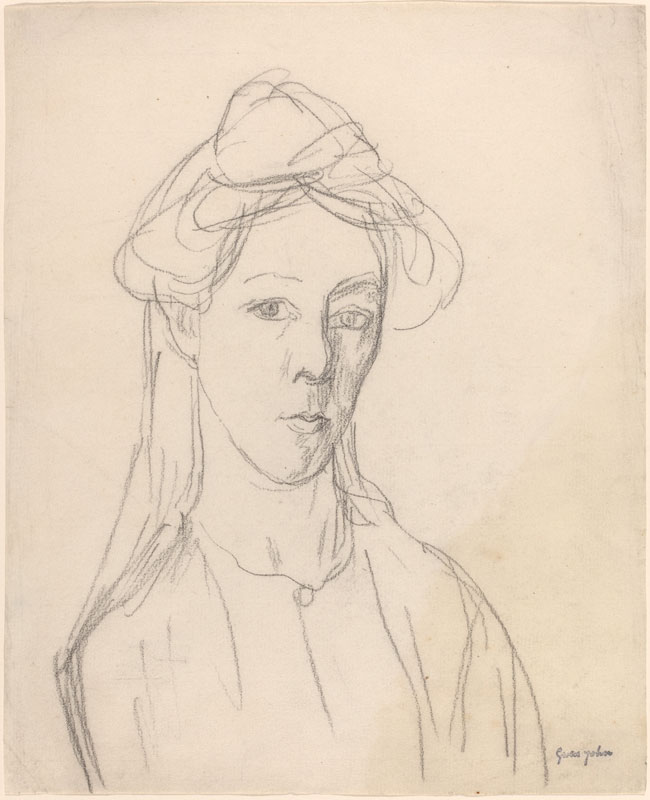
Sis Gwen (1876-1939) meanwhile was a talented artist in her own right. Only 18 months or so older than Augustus, she’d been born in Haverfordwest, but would do her painting mostly in France, where she died aged 63 just after the outbreak of WW2. She was largely overshadowed by her own brother, plus her lover, Auguste Rodin (1840-1917), he of ‘The Thinker’, but was an indisputable talent whose stock has risen posthumously. Also very close to the Bohemian-Austrian poet/novelist, Rainer Rilke (1875-1926), and the French philosopher, Jacques Maritain (1882-1973), Gwen became a Catholic, presumably influenced by Maritain who’d converted from Protestantism to Catholicism, and found her niche painting sombre pictures of orphaned children, nuns and cats, plus her own sister-in-law, Dorelia. I assume the sad cats had a fruitless day mousing, then found their bowls of milk and ‘Kitekat’ missing. Meanwhile, if you fancy checking out Augustus’s ‘Galway’ at the Tate, go for the double whammy and have a look at Gwen’s ‘Young Woman holding a Black Cat’. You can decide whether the black cat looks sad or not.
Words: Stephen Roberts
Chronology
1876 – Birth of Gwendolen Mary John in Haverfordwest (22nd June).
1878 – Augustus John born in Tenby (4th January).
1901 – Marriage of Augustus John and Ida Nettleship.
1907 – Death of Augustus John’s wife, Ida.
1911 – Augustus John moves into Alderney Manor, Poole, with Dorelia and 7 children.
1939 – Death of Gwen John, Dieppe, France (18th September) aged 63.
1942 – John awarded the Order of Merit (O.M.)
1961 – Death of Augustus John, Fordingbridge, Hampshire (31st October) aged 83
Photographs
0767 – The Lord Nelson, on Poole Quay, Dorset. On the right-hand side of the frontage is a blue plaque commemorating Augustus John (Steve Roberts).
0768 – Blue Plaque on the Lord Nelson, Poole Quay, Dorset. Augustus John drew inspiration from the Quay which is unsurprising as there’s always plenty of colour there (Steve Roberts).
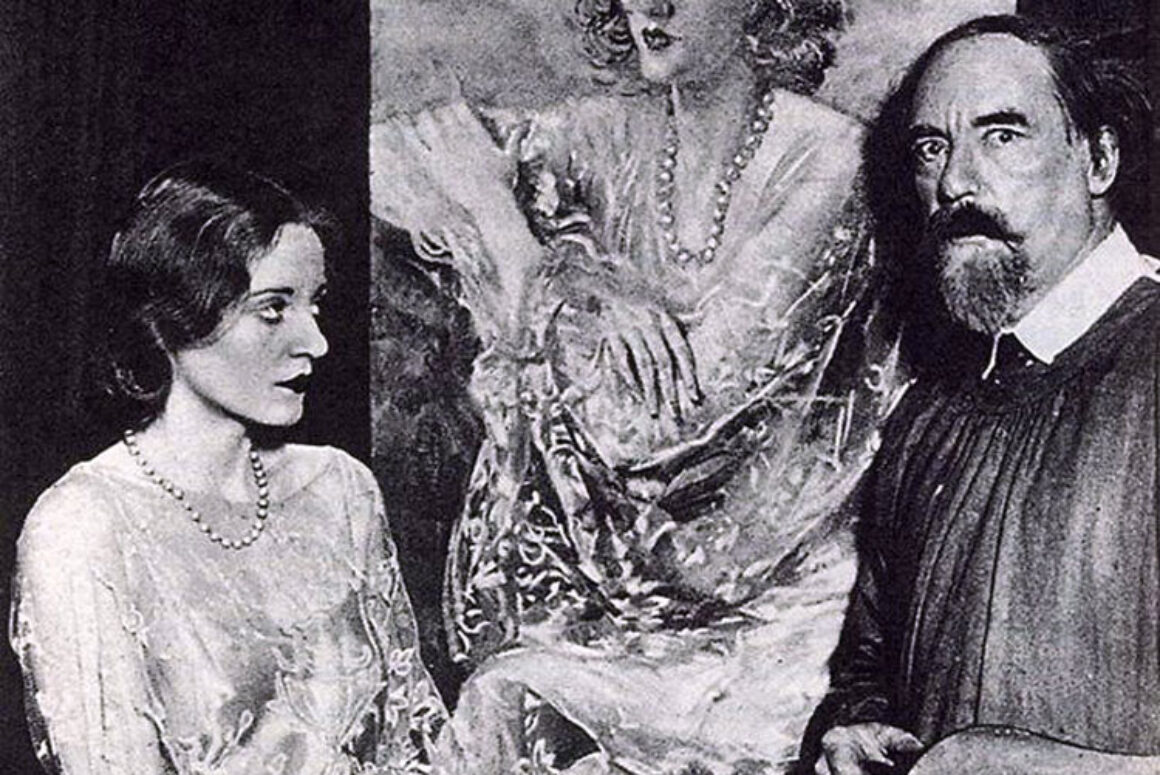
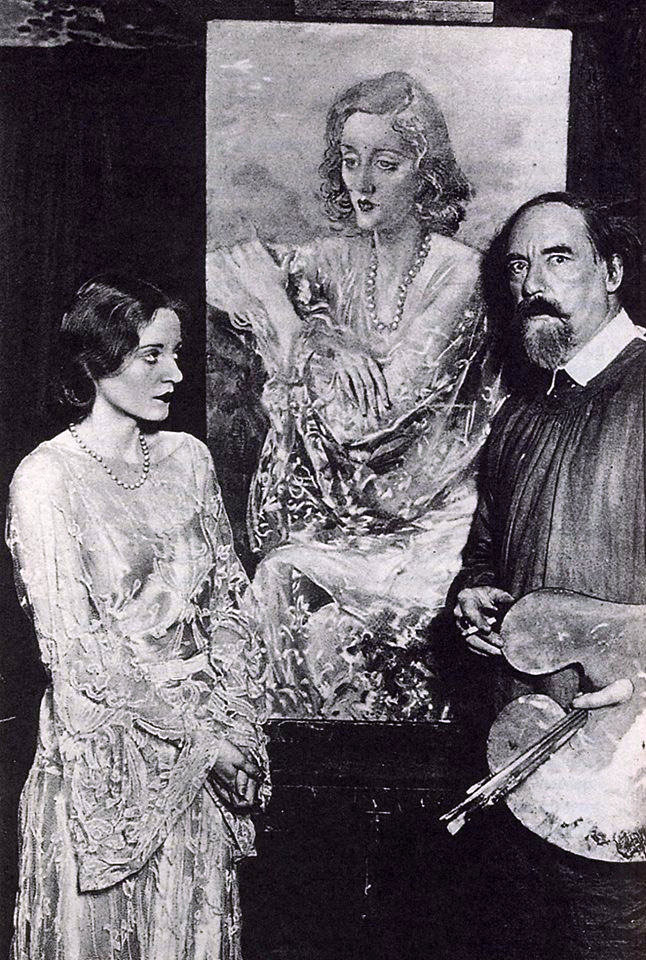
AJ-1 – Augustus John pictured with Tallulah Bankhead and her portrait (in the same outfit), 1929. The lady doesn’t look that impressed but Augustus is not to be argued with as he looks fearsomely bohemian (author – unknown).
AJ-2 – Looking typically sad, Gwen John, self-portrait, c.1907-09 (Gift of Mr and Mrs James T. Dyke, in honour of the 50th anniversary of the National Gallery of Art, Washington D.C. / www.nga.gov).
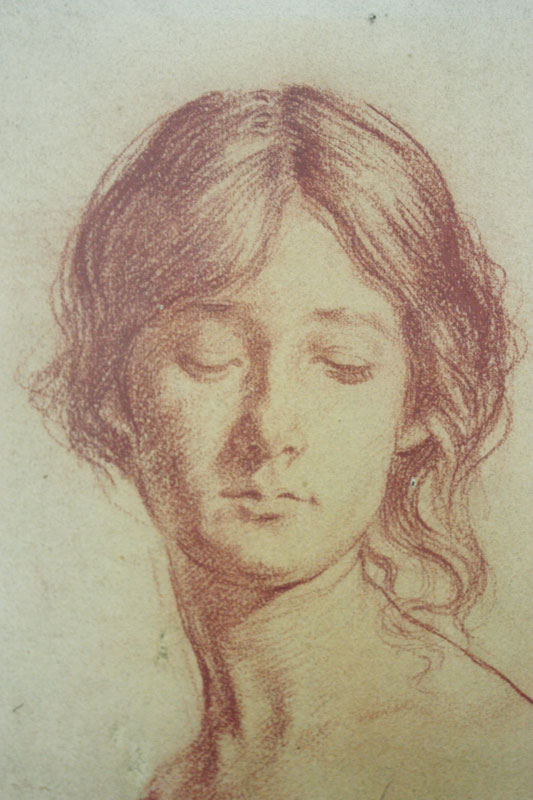
AJ-3 – Grace Westry, a chalk drawing by Augustus John, c.1897. Grace Westry attended the Slade School of Art alongside Augustus and Gwen John (Stephen C. Dickson).
AJ-4 – A view of Tenby Baths, c.1825. It was jumping into the sea and striking his head on to rocks which appeared to transform Augustus John into the flamboyant, chaotic person he became famous as (collection – National Library of Wales / www.library.wales).