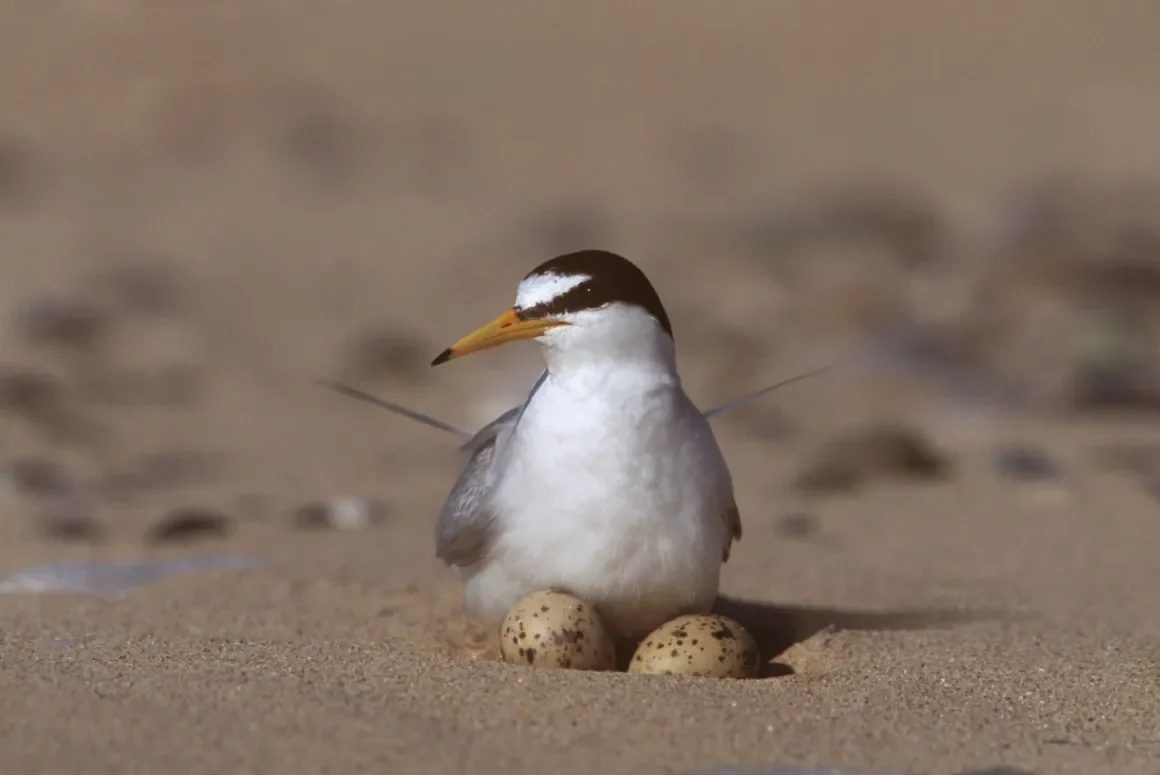
A famous Denbighshire bird colony has celebrated its 22nd season by supporting a stronger breeding summer and a diverse range of feathered guests visiting the site.
Denbighshire Countryside Service one again welcomed the Little Terns back to the colony at Gronant for the summer season.
This area is the largest breeding colony found in Wales. Gronant Dunes is known internationally as it contributes to over 10 percent of the entire UK breeding population as well as supporting other colonies.
Little Terns spend the winter in Africa; they arrived at the dunes during May to breed on the shingled beach in a protected site prepared in April by Countryside staff and volunteers and fly back south at the end of August. Nests consist of just a scrape in the sand, where pairs will take turns in incubating one to three eggs. The birds feed exclusively on a diet of sand eels, which they fish for out at sea.
Electric fenced pens and a section of strap fencing along the landward side of the colony were constructed to protect the breeding Little Terns.
Also, a boundary fence was implemented to prevent the public from accessing and disturbing the colony. However, the public could drop into a temporary observation centre at the tern shack and bird hide to find about and view the birds from afar.
Wardens on site helped look out for aerial predators and ground as well as engaging with the many visitors who come to Gronant each year
During 2026 the season saw 133 breeding pairs recorded, and a minimum total of 153 fledglings logged, an increase from last season.
Colony productivity was calculated at 1.15 fledglings per breeding pair, exceeding the productivity target of 0.7 fledglings per pair suggested by Cook and Robinson (2010) for maintaining a sustainable Little Tern population. This was again an increase on the 2025 season.
The wider site also supported a diverse breeding bird community. Ringed Plover and Oystercatcher successfully nested and raised young, while two pairs of Avocet produced broods of four and three chicks.
Marsh Harriers also successfully bred within the adjacent reedbed, with a recently fledged juvenile observed during July. A range of other waterbirds, waders and passerines also bred across the dunes, lagoon, saltmarsh and reedbed habitats
The North Wales Bird Ringing Team and Mersey Ringing Group ringed a number of birds under Schedule 1 licences and in accordance with British Trust for Ornithology (BTO) protocols. A total of 135 Little Tern chicks received BTO metal rings, of which 48 were also colour-ringed.
Observation of Little Terns at the Colony also found that birds from breeding colonies in Ireland, north east England and the Isle of Man continued to visit Gronant during 2026, reinforcing the importance of the colony within the wider network of Little Tern sites around the Irish Sea.
Visitors to the Tern Shack included around 500 people during the season. Eight organised groups visited the colony, including wildlife and birdwatching groups from Cheshire, North Wales and Shropshire, local community groups, and representatives from Denbighshire County Council and Natural Resources Wales.
Volunteers continued to play a vital role in the project, contributing 229 hours of support
Countryside staff operate a ‘no-trace’ policy at the colony site, and all equipment is taken off and stored until next spring arrives.
Garry Davies, Countryside Officer and County Allotments Manager, said:
“We, partners and volunteers are really proud to be involved with this project which has become so much more than the protection of a very rare seabird. Volunteering at the colony continues to be higher than any other activity offered by Countryside Services and it’s been great once again to see local groups visiting the colony.
“It has been a stronger season this year for the birds which is great for this species. The increase in the average of fledglings per breeding pair again this year shows how important this colony is to the future of the Little Terns. Its also been great to see the other diverse birds recorded around the colony which really shows how important this work is every year.
“The then Chair of Denbighshire County Council Bobby Feeley visited the Little Tern Colony and was particularly impressed by the tenacity and enthusiasm of staff. Despite working unsocial hours and in all weathers, they carried out their duties with enthusiasm and pride. It is this commitment that ensured that this very special and rare seabird had a successful breeding season.”
Cllr James Elson, Lead Member for Environment and Transport said:
“The protection of the Little Terns Colony at Gronant Dunes is immensely important for the survival of these under threat birds. It is heartening to hear that the 2026 season has been a stronger one for the Little Terns and our countryside teams, partner groups and volunteers can be proud of the work they have done to support the colony once again.”
Feature image: Little Tern with eggs
Credit: Michael Steciuk