Academics from Britain are supporting Ukrainians to rebuild their energy system with a new geo-thermal plant in the west of the war-torn country.
Russia’s destruction of energy infrastructure has made the modernisation of Ukraine’s power grid a matter of extreme urgency.
Led by mathematicians from Aberystwyth University, the project team’s solution is based on the “Rebuild Ukraine Back Better” principle.
They are aiming for a decentralised system based on a network of small-to-medium generating capacities that are harder to disrupt and aid a green transition.
The scientists believe that new geothermal power could strengthen energy resilience and sustainable supply in Ukraine, as well as offering lessons for Britain.
Their plan is to build a state-of-the-art geothermal energy plant in Solotvyno, near the border between Ukraine and Romania.
High geological risks and the long exploration phase – typically 7 to 8 years – are the main factors that slow down such developments.
The consortium of researchers from the UK, Ukraine, and Poland aim to speed up the process of building the pilot plant – by at least two years – through the development of mathematical models of rock properties at a microscopic level.
The researchers will use 3D models to provide accurate forecasting and mitigate risks. They will also devise new algorithms to predict reservoir behaviour over the whole life of the plant – up to 30 years.
This work will allow rapid deployment of the technology and the possibility to scale it up in geologically similar areas of Ukraine and elsewhere.
Professor Gennady Mishuris from Aberystwyth University, who recently held a workshop between the project partners in Wales, said:
“Our aim is to revolutionise how geothermal energy is explored and deployed, specifically focusing on the rapid recovery and modernisation of Ukraine’s energy infrastructure with enhanced geothermal systems.
“By combining world-class mathematical modelling with cutting-edge geomechanics and industrial expertise, we are not just solving a technical problem, we are building a decentralised, resilient, and carbon-neutral future for a nation in need.
“The project is more than a technical endeavour: it is a commitment to sustainability, social inclusion, and international solidarity. Aberystwyth University is proud to be at the helm, proving that through collaborative innovation, we can turn geological uncertainty into a stable, green, and prosperous future.”
Aberystwyth University academics are working on the project, “Geothermal Ukraine – Making a Difference in Technology for Rapid Deployment” alongside south Wales-based Rockfield Software Ltd, Ukrainian gas producer JSC “Ukrgasvydobuvannya”, Taras Shevchenko National University of Kyiv, Poland’s Oil and Gas Institute, and Solotvyno Local Council in Ukraine.
Aleksei Karpenko, from the Taras Shevchenko National University of Kyiv, added:
“This project drew on expertise that our team has developed over several decades. It combined knowledge and data dating back to the Soviet era with modern digitalisation, advanced analytical capabilities, and significant contributions from our in-house, physics-driven AI systems. The contributions of two outstanding female members of TSNUK team, Dr. Anastasia Chupryna and Dr. Mariia Kurylo, were crucial in this effort.
“I am proud that the results we delivered with our INIG colleagues have enabled our international partners to develop a comprehensive model of the thermal resources available in the region.
“All the Ukrainian partners are deeply grateful for the support provided by the UK to make this work possible.”
Dr Tomasz Topór from Poland’s Oil and Gas Institute, the National Research Institute, said:
“It was both a scientific and logistical challenge. Scientifically, we had to “go inside the rock” — understand its petrophysical, geomechanical and thermal properties at the microscale and translate them into geothermal system modelling.
“The key difficulty was the limited sample material. Small rock samples had to support a full sequence of laboratory tests, so every step required careful planning.
“We are proud that, despite different research tools and approaches, our results were largely consistent with and complementary to the interpretations of our project partners.”
Dr Martin Dutko from Wales-based Rockfield Software added:
“We’re delighted to take part in this challenging and exciting project. There was a limited amount of data available at the start and the geology is so complex. So, this is a difficult task to solve – we’re really pleased that with the help of our Ukrainian and Polish partners that made a great job in providing us with updated data allowing us to apply our sophisticated software to build the complete thermo-mechanical model.”
The project is supported by the Innovate Ukraine programme and UK International Development.
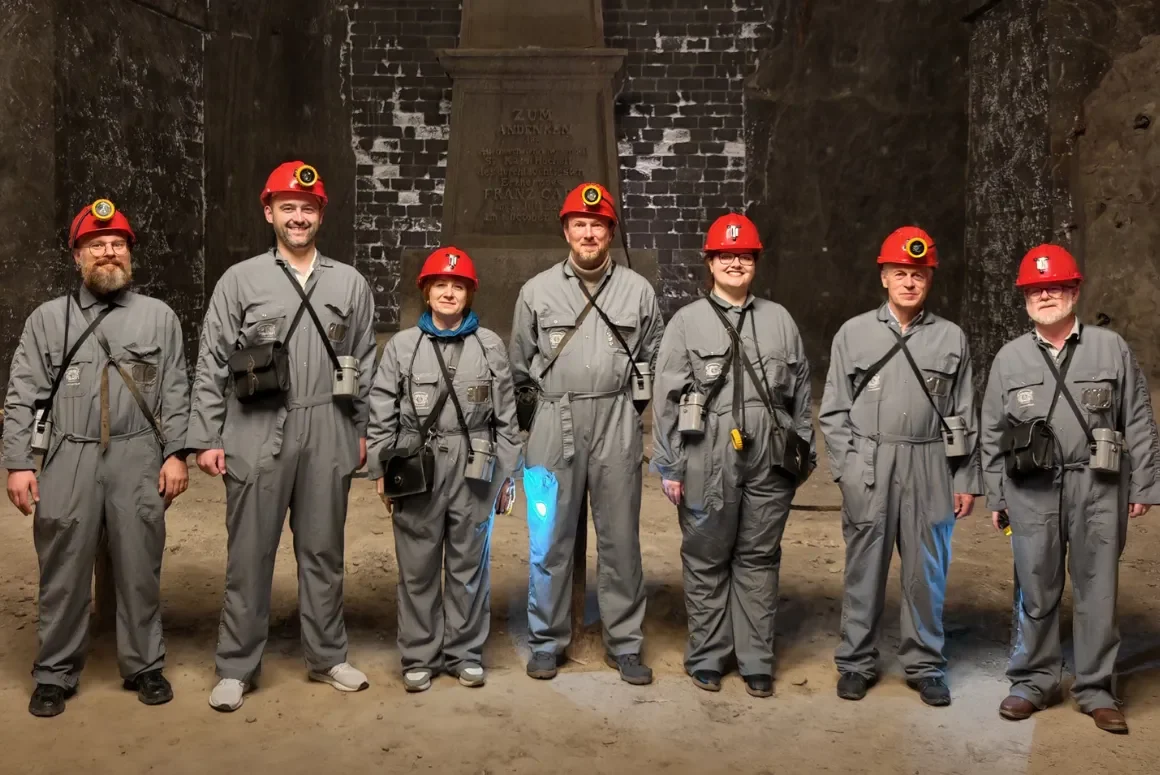
Feature image: Project partners during a salt mine visit supporting plans for a new geothermal plant