In an earlier piece, we wrote about the work of Amanda Webster and her fascination with light — those fleeting moments when sunlight filters through the landscape, falling in dappled patterns and changing the way we see people and places.
But perhaps there is another question worth asking: how do we actually look at a painting?
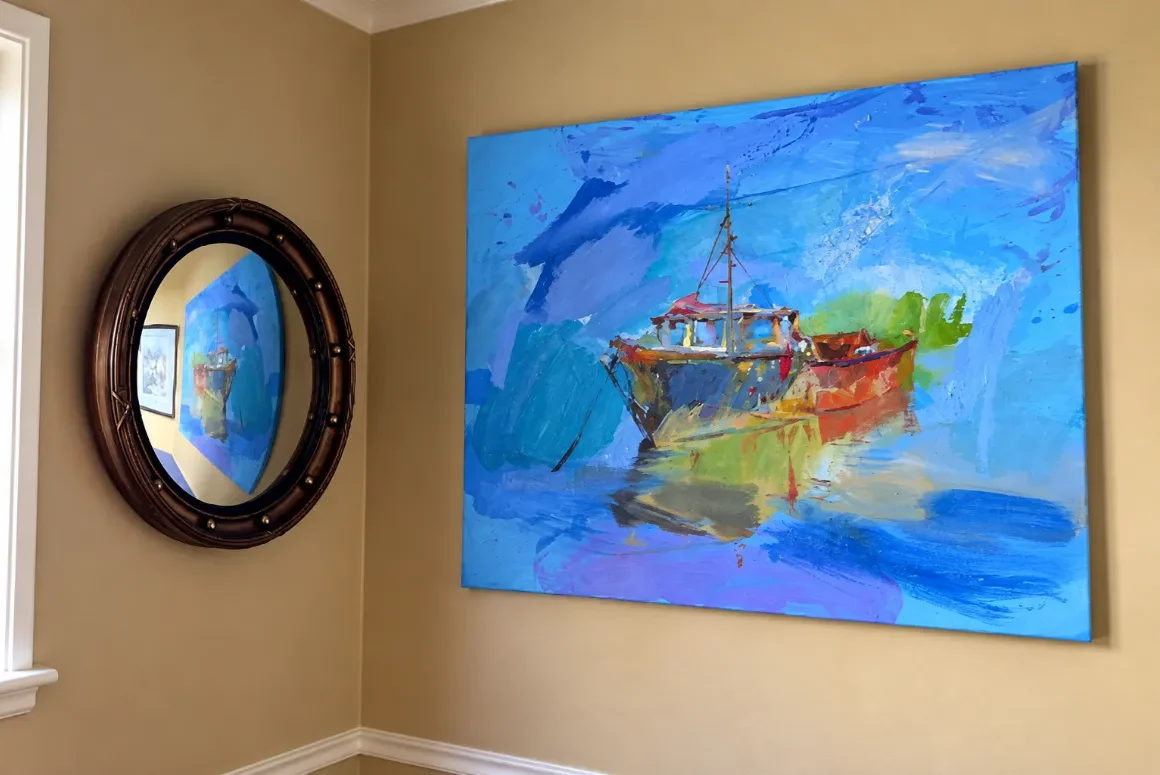
Usually, we stand directly in front of it. We accept the rectangle of the canvas as the artist’s chosen window and enter the world presented to us. Amanda’s boat, for example, sits within an expansive field of blue, its warmer reds, ochres and greens emerging through loose, expressive marks.
Then something rather wonderful happens when we move a few feet to one side.
In the convex fish-eye mirror hanging opposite, the same painting becomes something quite different. The rectangular canvas curves; the boat appears to recede into another space and the surrounding room becomes part of the composition. We are no longer simply looking at Amanda’s painting. We are looking at a reflection of it, within the gallery, from a particular place of our own choosing.
It brings to mind John Berger’s Ways of Seeing, first published in 1972:
“Every image embodies a way of seeing.”
Berger goes further. Looking, he argues, is not passive: “To look is an act of choice.”
Perhaps that is something we sometimes forget in galleries. There is no requirement to encounter a painting only square-on, at the regulation distance, with our hands politely behind our backs. Walk towards it. Step away. Look from the doorway. Catch it unexpectedly as you climb the stairs — or discover it transformed in an old convex mirror.
The painting hasn’t changed.
Our way of seeing it has.
And perhaps that is one of the quiet pleasures of living with art: there is always another way to look.
If you’d like to see more of our contemporary artwork at our gallery in Y Segontiwm call me to make an appointment, pop in on Friday evenings for a glass of wine and a chat or take a look online at Life: Full Colour
Sara McKee FRSA