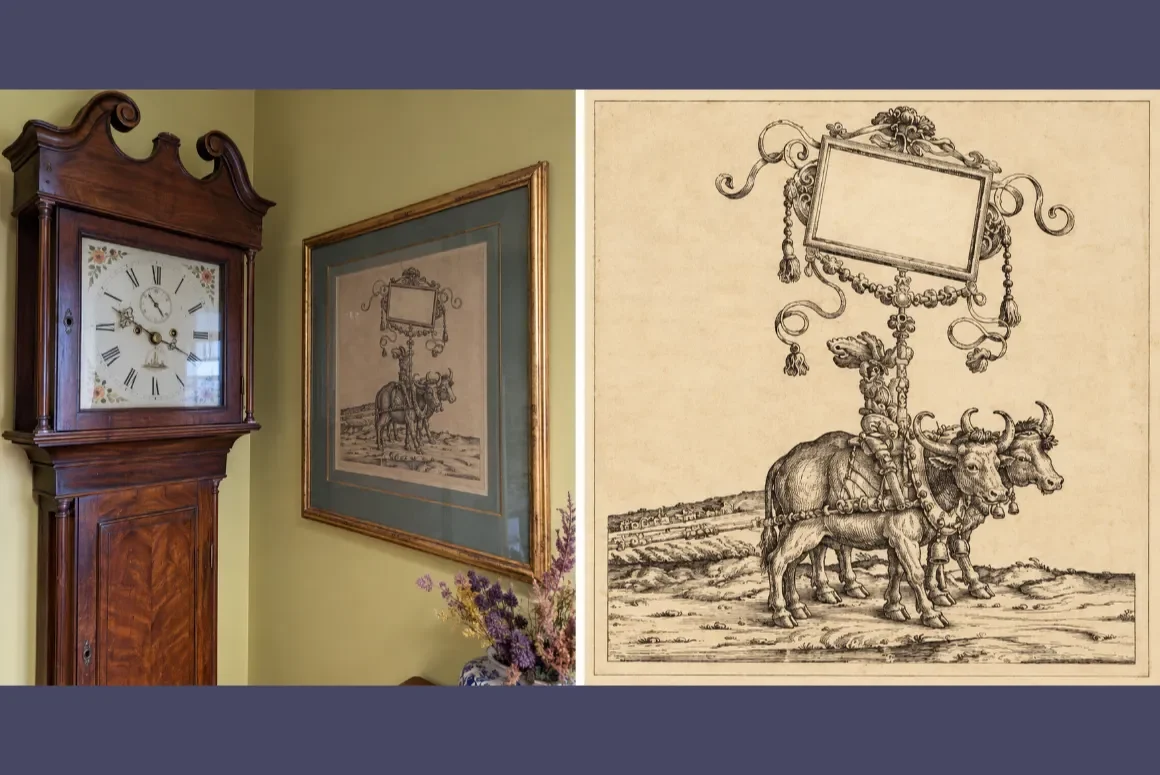
Some prints are collected for the image alone; others carry within them the history of printmaking itself. This woodcut by Hans Burgkmair the Elder (1473–1531) belongs to the latter category.
It forms part of The Triumphal Procession of Emperor Maximilian I, one of the most ambitious graphic projects of the German Renaissance. Conceived as an extraordinary procession extending almost 54 metres, the woodcut cycle brought together Burgkmair—the principal designer—with Albrecht Altdorfer, Hans Springinklee, Leonhard Beck, Hans Schäufelein and Albrecht Dürer. The blocks were created principally between 1516 and 1518. Maximilian died before the project was completed, and the first edition appeared in 1526.
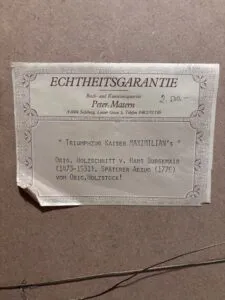
What makes the present impression particularly intriguing is its Salzburg antiquarian label, identifying it as a later impression from the original woodblock, traditionally dated 1776. Published scholarship records the second edition as 1777, followed by editions in 1796 and 1883–84, so the label’s 1776 dating deserves further investigation rather than being silently corrected.
Remarkably, the story can still be followed through major museum collections. The Albertina in Vienna preserves 135 original blocks; the British Museum’s collection includes impressions from the series, including eighteenth-century examples; and the Metropolitan Museum of Art in New York preserves later restrikes made from those Renaissance blocks.
For the serious print collector, this is therefore more than a decorative Renaissance image. It belongs to a physical chain connecting artist, block, printer and collector across centuries.
Its next owner will not simply acquire it. They will become its next custodian.
I would be delighted to start that conversation, please contact me at hello@lifefullcolour.com
Sara McKee FRSA